:::::::::::::::::::::::::::::::::::::::::::::::::::::::::::::::::::::::::::::::::::::::::::::::::::::
Hina Doll Festival (hina matsuri 雛祭り)
***** Location: Japan
***** Season: Mid-Spring
***** Category: Observance
*****************************
Explanation
March 3 (the double three date)

google logo, March 3, 2911
The third day of the third lunar month
had a climate similar to our present-day April. Due to the calendar differences with the lunar months, some rituals are placed in "late spring" and some regions celebrate this day on the third of April.
Double-dates like 3/3, 5/5, 9/9 were special festival days in Japan
. Names of Months and Calendar Systems .
The word DOLL here refers to the hina dolls, which are special and not the dolls girls play with every day.
For more about puppets and normal dolls, see below.
The word DOLL, by itself, is not a kigo but a topic for haiku.
The hina dolls are usually given to the girl at her birth by the grandparents and are kept as family mementos or passed on to the eldest daughter. To unpack them each year from their elaborate boxes is a joy for mother, grandmother and daughter, often versed in poetry as "bringing them to live", "let them see the world again" etc.
After the festival, the are wrapped and put back into their boxes, another party for mother, grandmother and daughters with more haiku to be written about.
:::::::::::::::::::::::::::::::::::::::::::::::::::::::::::::::::::::::::::::::::::::::::::::::::::::

(Unfortunately, the fans they once held were lost years ago.)
ancient women . . .
so long in service
without fans
- Shared by Elaine Andre
Joys of Japan, March 2012
:::::::::::::::::::::::::::::::::::::::::::::::::::::::::::::::::::::::::::::::::::::::::::::::::::::
Doll Festival, Peach Festival or Girl's Festival.
People pray for the happiness and healthy growth of girls and families with young daughters set up a display of dolls inside the house.The tradition goes back to the Edo Period (1603-1868). The dolls wear costumes of the imperial court during the Heian period (794-1192) and are placed on a platform with various tiers of five to seven layers.
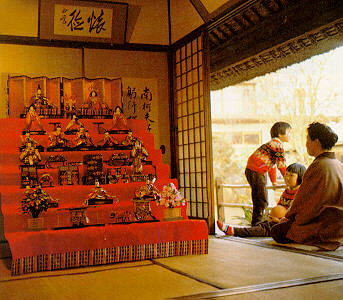
The top tier is for the Emperor and Empress. A miniature gilded folding screen is placed behind them as it was in the real court. The second tear has three ladies-in-waiting. The third has five male court musicians; the fourth has ministers sitting on either side of trays of food; the fifth has guards with an orange tree on the left and a cherry tree on the right.
The family celebrates with a special meal of diamond-shaped rick cakes and sweet shirazake which is rice malt with sake.The dolls are returned to their storage space after the festival is over since there is a superstition that families that are slow in putting the dolls away will have difficulty in marrying off their daughters.
© More in the WIKIPEDIA !
:::::::::::::::::::::::::::::::::::::::::::::::::::::::::::::::::::::::::::::::::::::::::::::::::::::

Hina Doll Decoration
shared by Kyoko Shibata
Joys of Japan
:::::::::::::::::::::::::::::::::::::::::::::::::::::::::::::::::::::::::::::::::::::::::::::::::::::
There are many kigo related to the customs of this important festival.
Let us look at some of them.
hina matsuri, 雛祭り (ひなまつり)
(Japanese) Doll Festival, Hina Doll Festival
playing with dolls, hina asobi 雛遊び
hina dolls, hina ningyoo 雛人形
Emperor Dolls, dairibina 内裏雛
Court Lady Dolls, kanjobina 官女雛
"five musicians", gonin bayashi 五人囃(ごにんばやし)
Minister Doll, yadaijin 矢大臣(やだいじん)
sannin shichoo 三人使丁(さんにんしちょう)
arranging dolls, hina awase 雛合(ひなあわせ)
雛の調度(ひなのちょうど)
雛の貝(ひなのかい)shells with dolls
. kaibina 貝びな hina dolls from hamaguri clams .
dolls on the shelf, hinadan 雛壇
dolls made from wood, kibori bina 木彫雛
dolls made from paper, kami bina 紙雛
dolls made from strings, ito bina 糸雛(いとびな)
dolls made from folded paper (origami), oribina 折雛(おりびな)

dolls from the Muromachi period, muromachibina
室町雛(むろまちびな)

dolls form the Kanei period, kanei bina
寛永雛(かんえいびな)

dolls from the Genrokuk period, genroku bina
元禄雛(げんろくびな)
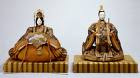
dolls from the Kyooho period, kyoohobina
享保雛(きょうほびな)
kyoobina 京雛(きょうびな)hina dolls from Kyoto
. Kokawabina, Kokawa bina 粉河雛(こかわびな)
hina dolls fro Kokawa .
Kishu, Wakayama
standing dolls, tachibina 立雛
first dolls for a girl, hatsu bina 初雛
old dolls, furubina 古雛
dolls given away, yuzuri bina 譲り雛
rice bowl for hina dolls, hina no wan 雛椀(ひなわん)
room with the doll shelf, hina no ma 雛の間
home with a doll shelf, hina no yado 雛の宿
food tray for the dolls, hina no zen 雛の膳
feasting with the dolls, hina no en 雛の宴
ricewine for the dolls, hina no sake 雛の酒
peach ricewine, momo no sake 桃の酒
sweets for the Doll festival, hina arare 雛あられ
More sweets for the Doll festival and sweet white rice wine
Shirazake 白酒 (しろざけ), hishi mochi 菱餅 (ひしもち)
market selling dolls, hina ichi 雛市
packing the dolls away, hina osame 雛収め
After the festival on the third of March, the dolls are packed away again for another year. They have special boxes to store them.
In some areas of Japan, it is the custom to
float old hina dolls in a boat after the festival (hina nagashi 雛流し, hina okuri 雛送り、 nagashibina 流し雛).
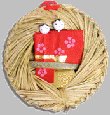
The dolls are placed in a small ship or round basked made of straw.
..........................................
box for the hina dolls, hina bako 雛箱(ひなばこ)
..... hina no hitsu 雛の櫃(ひなのひつ)
..... hina tsuzura 雛葛籠(ひなつづら)
:::::::::::::::::::::::::::::::::::::::::::::::::::::::::::::::::::::::::::::::::::::::::::::::::::

Peach Blossom Festival, momo no sekku
桃の節句 (もものせっく)
..... tooka no setsu 桃花の節(とうかのせつ)
March Seasonal Festival, sangatsu sekku
三月節句(さんがつせっく)
..... yayoi no sekku 弥生の節句(やよいのせっく)
Hina Doll seasonal festival, hina no sekku
雛の節句(ひなのせっく) "peach day", momo no hi 桃の日(もものひ)
.................................................................................
observance kigo for late spring
jooshi 上巳 (じょうし) "first day of the snake"
It used to be the first day of the snake in the third lunar month, but now it is celebrated on the third of March.

In China, people used to purify their body in a river before the rituals. This became the custom of floating hina dolls (nagashibina).
Also at the Imperial Court during the Heian period, people sat by a bent river and composed poetry 曲水の宴 (gyokusui no en), as a kind of purification ritual.
winding garden stream at a kyokusui-no-utage

gyokusui 曲水 (きょくすい) "meandering stream"
..... gokusui 曲水(ごくすい)
gyokusui no en 曲水の宴(きょくすいのえん)Party at the meandering stream
megurimizu no toyo akari 曲水の豊明(めぐりみずのとよあかり)
ryuushoo 流觴(りゅうしょう)
sakazuki nagashi 盃流(さかずきながし)floating cups with sake
The stream was located at the south-east part of the Imperial Palace park.
quote
A typical feature of Heian-period (794-1185) pond gardens was the yarimizu (遣水, 遣り水; kyokusui 曲水, a.p. gyokusui), or winding garden stream, although its inclusion in garden designs dates from the late Nara period (710-794). A popular Heian festival was the kyokusui-no-en (曲水の宴, a.p. kyokusui-no-utage), or the Feast of the Winding Stream, held in March each year. Poetry was composed and recited by courtiers dressed in elaborate dress who sat by the side of the winding stream, partaking of delicate edibles and peach sake as the cups and dishes floated gently by.
An account of this ceremony appears in Genji-monogatori (源氏物語 The Tale of Genji), and the festival has since been revived
at Mōtsū-ji Temple, Hiraizumi, where it is held annually in May.
source : www.japanesegardensonline.com
:::::::::::::::::::::::::::::::::::::::::::::::::::::::::::::::::::::::::::::::::::::::::::::::::::::
Daruma with his Missus as Hina Dolls

Made of Chocolate, Collection of Gabi Greve

Darumabina 達磨雛
.................................................................................
In our Library:
The Hina Matsuri, by Alan Plate
Antique Japanese Festival Dolls, by Timothy Mertel
:::::::::::::::::::::::::::::::::::::::::::::::::::::::::::::::::::::::::::::::::::::::::::::::::::::

source : www.asobo-saga
They wear robes of silk, with a special small pattern called
Nabeshima Komon 鍋島小紋.
The pattern imitates the kernels of sesame 胡麻柄 gomagara.
:::::::::::::::::::::::::::::::::::::::::::::::::::::::::::::::::::::::::::::::::::::::::::::::::::::
Ishii Rogetsu (1873-1928) and some Doll Festival Haiku
by Susumu Takiguchi
I do not have the time to find out when Rogetsu wrote this haiku but somehow I cannot help thinking that it has something to do with a series of tragedy whereby Rogetsu lost his daughters and son either as a child or a young person. When he was 35 years old he wrote a haiku on the same hina theme for his eldest daughter who was only three:
hina mo nashi nanji o momo no hana no kao
no hina dolls;
you are the flower face
of peach blossom
Hina-ichi no hitomoshi-goro o ame ga furu
As they were lighting up
In the Doll Market,
It was raining.
Hina-mise no hi o hiku koro ya haru no ame
Buson
As they were putting out
The lights of the doll shops,
The spring rain.
Read more in the World Haiku Review 2002
:::::::::::::::::::::::::::::::::::::::::::::::::::::::::::::::::::::::::::::::::::::::::::::::::::::
The Doll Festival at the Temple Hookyoo-Ji
(Hokyo-Ji, Hokyoji) in Kyoto 宝鏡寺の雛祭り
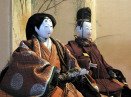
The main event is the graceful dance of a maiden, accompanied by traditional music with old instruments.
This temple is famous for its dolls, even called the "Doll Temple". It is also the first of the five great Nunneries in Kyoto, with strong ancient bonds to the Emperor and his family.
In Kyoto many families celebratethe Doll Festival on the 3rd of April according to the old lunar calendar. It might be in this season, because the peaches are blossoming at that time.
Speaking about Hina festival, as expected one refers to the Hina dolls. There is a doll exhibition of valuable Hina dolls and Gosho dolls, held at Hokyoji in Teranouchi at Kamigyo ward, spanning nearly 1 month, related to the Girls Festival. There is a memorial service in the temple precincts, dedicated to the important dolls and the following poem by Saneatsu Mushanokoji is carved on the doll mound:
'Nobody knows who made the doll
or who loved the doll,
but by loving
you enter the true Nirvana.'
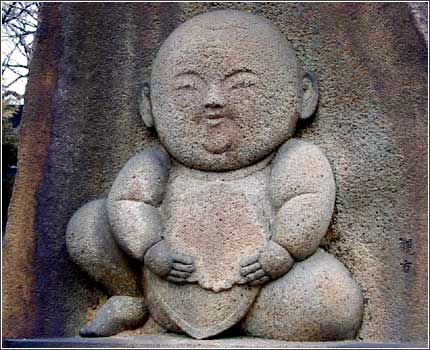
This doll mound gives an apropriate elegance to this gentle event and to this temple, also called the Doll temple.
http://www.city.kyoto.jp/koho/eng/preview/48.html
Twice a year, in spring and fall, this temple has a doll festival. This spring the festival runs from March 1 to April 3, and on the first day there will be a doll festival and Japanese dancing.

:::::::::::::::::::::::::::::::::::::::::::::::::::::::::::::::::::::::::::::::::::::::::::::::::::::
Hina Doll Festival at the Temple Hokkei-Ji, Nara
「雛会式(法華寺)Hina Eshiki Ceremony, small dolls' rites
Hina Kaishiki
From the first to the seventh of April.
This ceremony dates back to the Heian period. It had been visited by the many ladies-in-waiting of the court quarters. It is related to rites of the Kegon Sutra 華厳経.
Look at many photos of this famous temple
http://www.eonet.ne.jp/~kotonara/hokkejinoohanasi.htm
http://www.taleofgenji.org/hokkeji.html
. Hokkeji and Empress Komyo Kogo .
法華寺 and 光明皇后
:::::::::::::::::::::::::::::::::::::::::::::::::::::::::::::::::::::::::::::::::::::::::::::::::::::
quote
Hina Matsuri 雛祭 or 雛祭り
Doll Festival, Girls' Festival
- - - - - ALSO KNOWN AS THE
Snake Festival, Peach Blossom Festival,
or Drinking Around a Rolling Stream Festival
Japan's Doll Festival has a very curious history, one largely forgotten in contemporary times. Held on March three every year since the mid-to-late Edo period (1600-1867), it was originally a day for ritual purification known in Japanese as Jōshi no Sekku 上巳の節句 (literally "Seasonal Festival of the Snake") when people would rub their bodies with crude human-shaped figurines made of paper, straw, clay or wood. These figurines served as "scapegoats" for taking on (exorcising) the spiritual pollution and bad karma of the devotee (see below). The word for snake (Jōshi) sounds like the word for girl (Joshi 女子), so the festival eventually became a day devoted to girls.
Today the festival is a major joyous event but not a national holiday. Geared towards girls -- the first sekku 節句 (seasonal festival) after the birth of a baby girl -- it is a day when charming dolls are set out for display to symbolize the family's wish that their daughter will be healthy, free from calamity and able to obtain a happy life with a good husband. Also called the Peach Festival or Momo no Sekku 桃の節句, as March is the season when peach flowers are in bloom.
Jōshi no Sekku 上巳の節句 (original name for the Doll Festival in Japan). It literally means SEASONAL FESITVAL OF THE SNAKE, for the first day of the third month is the day of the snake. In China and Japan's old lunar calendar, this day occurred around March one (April one in today's solar calendar) and was thus also called Momo no Sekku 桃の節句 (literally Peach Blossoms Festival), for the peach trees are usually in full bloom at this time. On this day, people would perform symbolic ablutions or ritual cleansing to exorcise bad spirits. Such cleansing was performed by a pond or a river, with water and rice wine being used to cleanse the mouth, hands and feet.
Kyokusui no en 曲水の宴.
In later centuries, the festival day was changed to the third day of the third month in Japan, and known as Kyokusui no En, literally "Drinking Around a Rolling Stream." ...
Hinamatsuri 雛祭 or Doll Festival, March three every year. By the 16th or 17th century, the above traditions filtered down to the common people, who changed them into today's charming Doll Festival. ...
MORE
source : Mark Schumacher
:::::::::::::::::::::::::::::::::::::::::::::::::::::::::::::::::::::::::::::::::::::::::::::::::::::
tsurushibina, tsurushi bina つるし雛、吊るし雛
small hanging hina dolls and other dolls
from Onjuku choo 御宿町, Onjuku, Chiba
. tsurushibina folk art .
*****************************
Worldwide use
China
quote
master wang on the third day of the third month (蘭亭序)
Picnics and dolls-- what's not to love about this time of year? Most of the Dear Readers of These Pages will know that the Third Month in Japan is traditionally known as Yayoi. And, while there are various explanations for the origins of each of the other ancient names for the 12 months; for Yayoi, it is pretty unanimously agreed upon that yayoi means, "at last!" いよいよ
Yayoi:
"At last, the grasses and trees are beginning to grow!" 木草弥生月
Of course, everything got messed up with the adoption of the Gregorian calendar so in Japan-- unlike in China-- all the events are off by a month. But, anyway, it's not that hard to imagine yourself on a picnic, eating princess cake under a big blossoming peach tree, right? Yes, it is girl's day and in addition to dolls put out in people's homes, in Tochigi, girls will go out and float paper dolls in paper boats down the river.
In ancient China, any date with a double number, such as the Third day of the Third month (3/3), was considered to be highly auspicious. All the "double" days are marked in China as days of festivies and celebration. In Japan, for some reason, this custom was only taken on the odd numbered months (except Nov), so we have
Jan 1 (1/1 new year); March 3 (3/3 Girls Day); May 5 (5/5 Boys Day); July 7 (7/7 Star Festival); and Sept 9 (9/9 Chrysanthemum Festival).
Interestingly-- with the notable exception of the equinox holidays-- there are very few holidays in Japan that follow the ancient lunar-solar calendar as Japan wholeheartedly adopted the Western Gregorian calendar during the Meiji period. According to the solar-lunar ancient calendar, March 3 actually should fall sometime in early April-- which is when the peach blossoms actually blossom (nowadays flower companies grow special peach trees which blossom a full month early in March to coincide with the holiday). Early April, when the holiday originally fell, is a time when the seasons change (from cold days to warmer days).
Seasonal transition times are known as kisetsu no kawarime (or "seasonal turnings of the year") and there were special days, known as sechi nichi (節日) in ancient Japan, to mark these seasonal transitions. At Court and among the aristocracy special banquets (with special nourishing foods to guard against sickness) and rituals (to guard against evil) were held as ancient people believed that the body was vulnerable to sickness and bad luck during these periods. Even today, it is a very common greeting during these times of the year is to wish someone good health with the phrase: "be careful not to catch a cold."
source : www.tangdynastytimes.com
:::::::::::::::::::::::::::::::::::::::::::::::::::::::::::::::::::::::::::::::::::::::::::::::::::::
Germany
Puppenfest
Ein japanisches Mädchenfest
Tag des Mädchens
:::::::::::::::::::::::::::::::::::::::::::::::::::::::::::::::::::::::::::::::::::::::::::::::::::::
India
. Golu Doll Festival .
and Navrathri, the Nine Day Festival
*****************************
Things found on the way

source : www.b-shoku.jp
:::::::::::::::::::::::::::::::::::::::::::::::::::::::::::::::::::::::::::::::::::::::::::::::::::::

- quote
Doll diplomacy
'Hina' dolls depicting Prime Minister Shinzo Abe and U.S. Ambassador to Japan Caroline Kennedy are displayed at Kyugetsu doll company in Taito Ward, Tokyo, on Thursday. The special dolls were set up in advance of the Hinamatsuri (Doll Festival) celebrated on Girls' Day on March 3. The kanji between the Japanese and U.S. flags reads: 'Friendship.'
- source : www.japantimes.co.jp - January 2014
*****************************
HAIKU

- source : Naokimi Yamada 2018 -
草の戸も住替る代ぞひなの家
kusa no to mo sumikawaru yo zo hina no ie
this old thatched hut
will change inhabitants now -
a home with dolls
(Tr. Gabi Greve)
Matsuo Basho, at the start of his long Journey to the North of Japan, Oku no Hosomichi
Oku no Hosomichi - - - - Station 1 - Prologue 出発まで - - -
. Matsuo Basho 松尾芭蕉 - Archives of the WKD .
内裏雛人形天皇の御宇とかや
dairibina ningyoo tennoo no gyo u to ka ya
Dairi-bina,
The Emperor Ningyo
Really reigns today!
Tr. Oseko
. Matsuo Basho 松尾芭蕉 - Archives of the WKD .
:::::::::::::::::::::::::::::::::::::::::::::::::::::::::::::::::::::::::::::::::::::::::::::::::::::
妹が家も田舎雛ではなかりけり
imo ga ya mo inaka hina de wa nakari keri
in my lover's house
not one provincial doll
on Doll's Day
ちる花に御目を塞ぐ雛哉
chiru hana ni on-me o fusagu hiina kana
closing her eyes
to the scattering blossoms...
the doll
Read more :
Doll Festival, Haiku by Issa (Tr. David Lanoue)
inarande Daruma mo hina no nakama kana
lined up too
among the dolls...
Dharma
(Haiga by Nakamura Sakuo)
Issa and more Daruma Haiku
imo ga ie mo inaka hina de wa nakarikeri
at the house
of my lover, too
no country-style dolls
. Comment by Chris Drake .
hina-tachi ni hanashi shikakeru kodomo kana
the child tries
to get festival dolls
to talk back
. Comment by Chris Drake .
:::::::::::::::::::::::::::::::::::::::::::::::::::::::::::::::::::::::::::::::::::::::::::::::::::::
once a year
hina dolls are slightly flushed
with white sake
- Shared by Kyoko Shibata
Joys of Japan, March 2012
:::::::::::::::::::::::::::::::::::::::::::::::::::::::::::::::::::::::::::::::::::::::::::::::::::::

Hina Sushi

My Hina-ningyo which are the dolls for Hina-Matsuri half century ago.
And me half century ago.
Grand-parents present the dolls to their grand-daughters at the first festival.
- Shared by Mieko Motoyama
Joys of Japan, March 2012
:::::::::::::::::::::::::::::::::::::::::::::::::::::::::::::::::::::::::::::::::::::::::::::::::::::
te ni toreba haya niko-niko to uri-hina
Picking it up,
Soon I was smiling;
Dolls for sale.
Baishitsu (1768-1852), Tr. Blyth
umazume no hina kashizuku zo aware naru
The childless woman,
How tender she is
To the dolls!
Ransetsu (1654-1707), Tr. Blyth
hina no kao ware zehi naku mo oinikeri
The faces of the dolls!
Though I never intended to,
I have grown old.
Seifu (1732-1815), Tr. Blyth [Seifu is a woman]
unchanging dolls' faces--
I've had no choice, except
to grow old
Tr. Ueda

hosoki hi ni yosugara hina no hikari kana
softly lit...
all night the hina dolls
faintly shining
Buson (1716-1784), Tr. Shigeki Matsumura
obina yori mebina hookan dake takashi
Empress doll on stand,
taller than the Emperor
by only her crown.
Seishi (1901-1994), Tr, Kodaira and Marks
compiled by Larry Bole
Happy Haiku Forum March 2012
*****************************
Related words
***** . nochi no hina 後の雛 (のちのひな)
"the next doll festival"
aki no hina 秋の雛(あきのひな)"hina dolls in autumn"
kikubina 菊雛(きくびな) chrysanthemum dolls
(on the ninth day of the ninth lunar month)
***** WKD World Kigo Database: March
. Puppets and Dolls and Kigo
Nagata jinja kamibina 長田神社神雛 "dolls of the Gods"
. Nagata Shrine in Kobe 長田神社 神戸 .
Aoshima jinja no kamibina 青島神社の神雛 "dolls of the Gods"
. Aoshima shrine 青島神社 Miyazaki .
. itobina 糸雛 string hina dolls .
Satsuma itobina 薩摩糸びな Satsuma string hina dolls
From Kagoshima, Miyazaki
. tatsubina 辰雛 Dragon hina dolls .
. uumen ウーメン(紙びな)hina dolls from paper .
Okinawa
:::::::::::::::::::::::::::::::::::::::::::::::::::::::::::::::::::::::::::::::::::::::::::::::::::::
. kamishimobina, kamishimo hina 裃雛
hina dolls in kamishimo robes .
. . . . . and
kosei bina 古製雛 old hina dolls from Konosu town, Saitama

Sushi as Hina Dolls
WASHOKU ... Japanese Food SAIJIKI
. Awashima Matsuri 淡島祭 Awashima festival
Empress Jingu Kogo 神功皇后
. Jingu Kogo and Japanese Dolls .
. Hanayome ningyoo 花嫁人形 bride dolls .

Hina Doll Cats
- Shared by Esho Shimazu
Joys of Japan, March 2012
[ . BACK to DARUMA MUSEUM TOP . ]
[ . BACK to WORLDKIGO . TOP . ]
:::::::::::::::::::::::::::::::::::::::::::::::::::::::::::::::::::::::::::::::::::::::::::::::::::::







 Posts
Posts