:::::::::::::::::::::::::::::::::::::::::::::::::::::::::::::::::::::::::::::::::::::::::::::::::::::
Withering Wind, Cold Gale (kogarashi)
***** Location: Japan, other areas
***** Season: Early Winter
***** Category: Heavens
*****************************
Explanation
This is one of the first really cold winds, when the last leaves are swept from the trees. Literally it means "tree-witherer".
withering wind, cold wind
kogarashi 木枯らし, 木枯, 凩
Echigo Mountains, Echigo Yama, see below
:::::::::::::::::::::::::::::::::::::::::::::::::::::::::::::::::::::::::::::::::::::::::::::::::::::
World Haiku Review
COLD WIND, by Susumu Takiguch
In the Edo Period, kogarashi was used either for autumn or winter, but it is now a kigo for early winter. It is the cold and strong north or west wind in October and November, which withers leaves and blows them off the trees. However, it seems that the emphasis is more on the strength of the wind than on its coldness.
kogarashi ya umi ni yuhi o fuki-otosu
(Natsume Soseki)
withering wind
blows the setting sun
down to the sea
(ST version)
kogarashi ya hoshi fuki-kobosu umi no ue
(Masaoka Shiki)
withering wind --
stars are blown scattered
over the sea
(ST version)
kogarashi ya ishi fuki-tobasu Ohi-gawa
(Hasegawa Reyoko)
winter gale --
blowing rocks away
at the Ohi-gawa River
(ST version)
kogarashi ni Asama no kemuri fuki-chiru ka
(Takahama Kyoshi)
withering wind --
would the smoke of Asama vocano
be blown everywhere
(ST version)
Some other samples where the strength of kogarashi is not that apparent: -
kogarashi no hikkakari iru toge no ki
(Hara Yutaka)
withering wind --
caught and hanging on
to the hilltop tree
(ST version)
kogarashi ya me yori toridasu ishi no tsubu
(Watanabe Hakusen)
winter gale --
I get out grit
from my eyes
(ST version)
umi ni dete kogarashi kaeru tokoro nashi
(Yamaguchi Seishi)
blowing into the sea
withering wind has now
no place to return
(ST version)
*This haiku was written in October 1944 and the Kamikaze pilots were flying to the sea then.
kogarashi ya mezashi ni nokoru umi no iro
(Akutagawa Ryunosuke)
withering wind --
faint on the dried sardines
the colour of the sea
(ST version)
*****************************
Worldwide use
*****************************
Things found on the way
*****************************
HAIKU
> kogarashi ga
> iki o hisomeru
> ike no fuchi
The wintry wind
Hides its breath
In the pond's depths
Toshiaki from Canda: A Love Story enfolds
xxxxxxxxxxxxxxxxxxxxxxxxxxxxx
木枯らしの吹き行くうしろ姿かな
嵐雪
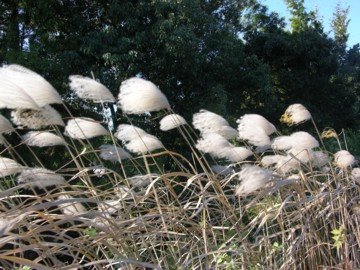
kogarashi no fukiyuku ushirosugata kana
withering winds -
blow and gone, we see
its backside now
(Tr. Gabi Greve)
写真は木枯らし1号に耐える尾花
東松山葛袋, 撮影 11月13日
http://www.geocities.jp/tokihikok/masaji/haiku/oriori/2004/fuyu/kogarashi.html
xxxxxxxxxxxxxxxxxxxxxxxxxxxxx
kogarashi no hate wa arikeri umi no oto
bitter winter wind
ends there --
sound of the sea
IKENISHI Gonsui (1650-1722)
comment:
The word kogarashi reminds us Japanese of the bitter cold wind in the winter which may be beyond imagination for people in warmer countries. I have spent some winters in a colder country than Japan, but I felt the Japanese winter was much colder than that. It may be because of the moisture and the housing architecture. The kogarashi in the Edo Period must have been much severer than now, which may explain the reason why this haiku became popular then.
Gonsui, later surely influenced modern poets like YAMAGUCHI Seishi who wrote a related haiku about the WW II suicide bomber pilots in his famous haiku:
umi ni dete kogarashi kaeru tokoro nashi
out to the sea --
bitter winter wind
has no place to return
Haiku Selected by SATO Kazuo
http://www.haiku-hia.com/kongetsu_en05.html
:::::::::::::::::::::::::::::::::::::::::::::::::::::::::::::::::::::::::::::::::::::::::::::::::::::
木枯しや竹に隠れてしづまりぬ
kogarashi ya take ni kakurete shizumarinu
The cut marker YA is at the end of line 1.
. Matsuo Basho 松尾芭蕉 - Archives of the WKD .
Amid the wintry gust
Disappears amid the bamboos
And subsides to a calm
(Tr. Toshinaka)
(note the opposition of motion and stillness in the poem, "there is a delicate harmony between the two senses"(Ueda, 48))
http://mll.kenyon.edu/~japanese02/J28sp99/projects/tohinaka/1/1.html
A wintry gust
disappears amid the bamboos
and subsides to a calm.
(© Makoto Ueda)
Порывистый листобой
спрятался в рощу бамбука
и понемногу утих.
(© Вера Маркова)
http://homepage.ntlworld.com/dmitrismirnov/BASHO_Haiku_K2.html
withering gales !
they hide in the bamboo
and subside
(Tr. Gabi Greve, 2006)
Here is a photo of my bamboo grove. Click on the photo to see more !
More versions of this haiku and a discussion of kogarashi and fuyu no arashi (winter storm):
The winter tempest
Hid itself in the bamboos,
And grew still.
Tr. Blyth
The winter storm
hid in the bamboo grove
and quieted away.
Tr. Robert Hass
a withering wind
hiding in the bamboo
has calmed down
Tr. Reichhold
The winter storm
hides in the bamboo
and becomes silent
Tr. Stephen Addiss (with Fumiko and Akira Yamamoto)
Comiled by Larry Bole
Translating Haiku Forum
... ... ...
poliyunna kaatu
mulangoottathil
olinju illaathaay
this Haiku in Malayalam, by Narayanan Raghunathan
... ... ...
withering wind
hidden in the bamboo
subsides
Tr. Grzegorz Sionkowski. Read the discussion too.
:::::::::::::::::::::::::::::::::::::::::::::::::::::::::::::::::::::::::::::::::::::::::::::::::::::::
kyooku 狂句 Kyoku, comic verse - a wild verse
木枯の身は竹斎に似たる哉
kogarashi no mi wa Chikusai ni nitaru kana
in winter's wind
don't I look
just like Chikusai
Tr. Barnhill
Written in 1648, Nozarashi Kiko
In from a gale,
looking like Chikusai,
the mad quack!
Tr. Robin D. Gill
MORE about kyooku :
source : books.google.co.jp
In den Winterböen
ein Wanderer ... dem Chikusai ähnlich
bin ich geworden!
Tr. Udo Wenzel
my body
in this withering wind
resembles Chikusai ...
Tr. Gabi Greve
This hokku has the cut marker KANA at the end of line 3.
Chikusai was a doctor, famous at his time through an illustrated story book, kana zooshi 仮名草子.
Chikusai wrote a lot of "wild verse" and did not take good care of his patients.
The stories were penned by Tomiyama Doya 富山道冶
Other sources name Karasumaru Mitsuhiro 烏丸光広.
Basho here compares his own miserable, poor life with that of the shabby doctor.

The light-hearted doctor Chikusai travels all around Japan, getting involved in regional troubles and stories, writing his "wild verse" about it, thus also contributing to the spread of haikai.
Chikusai Monogatari 竹斎物語 "The Tale of Chikisai"
Partial translation by Edward Putzar
source : www.jstor.org
. Matsuo Basho 松尾芭蕉 - Archives of the WKD .
. zooshi 草子 stories of Japan .
. kyooku 狂句 Kyoku comic verse (of the haiku type) .
and other eccentric poetry
:::::::::::::::::::::::::::::::::::::::::::::::::::::::::::::::::::::::::::::::::::::::::::::::::::::
山寺や木がらしの上に寝るがごと
yamadera ya kogarashi no ue ni neru ga goto
Kobayashi Issa
mountain temple--
like it's lying down
on the winter wind
Hiroshi Kobori comments on the word, kogarashi ("winter wind").
In early Japanese poetry, this refers to the wind that blows through trees, breaking branches and turning the leaves brown. By Issa's time it means "a dry windy day during the late autumn--deep winter season."
It is classified as a winter season word.
More haiku about the "kogarashi" from Issa
Tr. David Lanoue
:::::::::::::::::::::::::::::::::::::::::::::::::::::::::::::::::::::::::::::::::::::::::::::::::::::
Echigo Mountains Echigo yama
越後山 えちごやま
こがらしや隣と云もえちご山
kogarashi ya kabe no ushiro wa Echigo yama
winter wind--
behind the wall
is the deep north
Issa (tr. David Lanoue)
Issa ends this haiku with the phrase, echigo yama ("Echigo mountain[s]"). Echigo is one of the old provinces of Japan, today's Niigata Prefecture. A northern land, it is famous for its coldness. For this reason, French translator L. Mabesoone renders the closing phrase, as ("la frontière du nord": "the northern frontier"; Issa to kuhi (Tokyo: Kankohkai 2003) 49.
This seems a reasonable solution to the following problem: in Issa's time "the mountains of Echigo" would have been synonymous with a cold place in the north, but for most English readers this connotation is nonexistent.
ледяной ветер
застеной начинаетсяполя
рная ночь
(Russian by Eugene Wasserstrom)
Later Issa wrote this haiku
川向ふ隣と云もえちご山
kawa mukau tonari to iu mo Echigo yama
facing the river--
next door, it seems
Echigo mountains
. . . . .
夜涼や足でかぞへるえちご山
yo suzumi ya ashi de kazoeru Echigo yama
evening cool--
with my feet counting
the mountains of Echigo
"Evening cool" is a kigo for summer.
MOREHaiku by Issa about the cold Echigo Mountains
*****************************
Related words
***** WIND in various kigo
[ . BACK to WORLDKIGO . TOP . ]
:::::::::::::::::::::::::::::::::::::::::::::::::::::::::::::::::::::::::::::::::::::::::::::::::::::




 Posts
Posts



11 comments:
::::::::::::::::::::::::::::::::::::::::::::::::::::::::::::::::::::::
kogarashi ya kabe no ushiro wa echigo yama
winter wind--
behind the wall
is the deep north
Issa (tr. David Lanoue)
::::::::::::::::::::::::::::::::::::::::::::::::::::::::::::::::::::::
摘みけんや茶を凩の秋とも知らで
tsumiken ya / cha o kogarashi no / aki to mo shirade
Matsuo Basho
木枯しに岩吹きとがる杉間かなkogarashi ni / iwa fuki togaru / sugi ma kana
凩に匂ひやつけし返り花
kogarashi ni / nioi ya tsukeshi / kaeri-bana
こがらしや頬腫痛む人の顔
kogarashi ya / hōbare itamu / hito no kao
Matsuo Basho
Drinking tea with Matsuo Basho!
Matsuo Basho
京に飽きてこの木枯や冬住ひ
京に倦てこの凩や冬住居
Kyoo ni akite kono kogarashi ya fuyuzumai
getting bored of Kyoto
and now this ice-cold wind -
my lodging in winter
at the home of - Suganuma Gon-emon 菅沼権右衛門 -
Matsuo Basho
木枯に岩吹きとがる杉間かな
kogarashi ni iwa fukitogaru sugima kana
by this cold gale
the rocks are sharpened
among the cedar trees . . .
At temple Horai-Ji
MORE
.
Yosa Buson
蕪村こがらしや炭売ひとりわたし舟
kogarashi ya sumiuri hitori watashibune
withering wind -
only one charcoal seller
on the ferry boat
MORE about sumiuri
Yosa Buson
kogarashi ya ishibumi o yomu soo hitori
withering wind -
one priest reading
words carved in stone
priest, monk
Yosa Buson
kogarashi
木枯や鐘に小石を吹きあてる 与謝蕪村
凩に鰓(えら)吹るるや鉤(かぎ)の魚 与謝蕪村
こがらしや何に世わたる家五軒 与謝蕪村
木がらしや石に下堂の沓(くつ)の音 与謝蕪村
こがらしや岩に裂け行く水の声 与謝蕪村
こがらしや畠の小石目に見ゆる 与謝蕪村
凩やこの頃までは萩の風 与謝蕪村
木がらしや小石のこける板びさし 与謝蕪村
こがらしや野川の石をふみわたる 与謝蕪村
こがらしや炭売ひとりわたし舟 与謝蕪村
凩や釘のかしらを戸に怒る 与謝蕪村
こがらしや広野にどうと吹起る 与謝蕪村
凩や碑(いしぶみ)をよむ僧一人 与謝蕪村
こがらしやひたとつまづく戻り馬 与謝蕪村
TBA
.
Natsume Sokeki
kogarashi no ima ya fuku tomo chiru ha nashi
Bitter winter wind --
blowing now
yet no leaves to drop.
Tr. Haiku International Association
.
Kobayashi Issa
木がらしやいわしをくるむ柏の葉
kogarashi ya iwashi o kurumu kashiwa no ha
winter windstorm
wraps a big oak leaf
around a sardine
Tr. Chris Drake
MORE about the kashiwa tree
.
Post a Comment