:::::::::::::::::::::::::::::::::::::::::::::::::::::::::::::::::::::::::::::::::::::::::::::::::::::
Pink, Fringed Pinks, wild carnation
(nadeshiko, Japan)
***** Location: Japan, other areas
***** Season: Late Summer
***** Category: Plant
*****************************
Explanation
Walking my usual way toward the local shrine, the terraced rice fields below on the right, the pink-colored slopes on the left - yes, it is time for the PINK with the fringed petals and its fragrant smell.
This flower has been introduced to Japan from China and is known for its medical properties too. It comes in white, pink and lilac, altogether more than 300 varieties. It blooms from June to August and is also one of the seven herbs and flowers of Autumn, but as a kigo, it represents the late summer.
Seven Flowers of Autumn (aki no nanakusa).. Seven Herbs of Autumn
Its precious little flower with the fringed petals reminds us of a lover or beloved child and since the Heian period the characters 撫子 were used to represent this flower. Literally it means a child (ko 子) so sweet it is stroked (nade 撫).
The Chinese Nadeshiko (kara nadeshiko 唐撫子) was also introduced during the Heian period, but nowadays the Japanese Nadashiko (yamato nadeshiko 大和撫子) is more common.
This flower is the subject of many poems in the Manyoo-Shuu 万葉集 "Collection of Ten Thousand Leaves" . It is a symbol of a flower planted in spring, bringing forth its flowers (the fruit of love) in autumn.
Some of the older names are tokonatsu (常夏), literally "endless summer" and omohigusa, omoigusa (思草).
Let us look at some other Japanese names for this plant.
fringed pink (Dianthus superbus) nadeshiko 撫子
kawara nadeshiko 河原撫子 (.it. pink by the river)
hime nadeshiko 姫撫子 (lit. Princess Pink)
shimofuri nadeshiko 霜降撫子 (lit. falling frost pink)
Shinano nadeshiko 信濃撫子 (Dianthus shinanensis)
fuji nadeshiko 藤撫子 (lit. Wisteria pink)
kumoi nadeshiko 雲井撫子
takane nadeshiko 高嶺撫子(lit. pink of high mountains) (Dianthus superbus var. speciosus),
hama nadeshiko 浜撫子(lit. pink on the beach) (Dianthus japonicus)

English names: superb pink, wild carnation
German names: Prachtnelke, wilde Nelke
Yamato Nadeshiko 大和撫子, a comely Japanese maiden
relates a bit to this one
Yamato-damashii 大和魂, the Japanese spirit
Gabi Greve

source : facebook Ukiyo-e & sumi-e
"Three Young Women in a Garden where Nadeshiko Pinks are Growing"
Kuwagata Keisai (also known as Kitao Masayoshi) (1764-1824)
:::::::::::::::::::::::::::::::::::::::::::::::::::::::::::::::::::::::::::::::::::::::::::::::::::::
kigo for early summer
furokkusu フロックス Phlox
kikyoo nadeshiko 桔梗撫子(ききょうなでしこ)
"bellflower nadeshiko"
. oiransoo 花魁草 Phlox paniculata .
.................................................................................
kigo for mid-summer
mushitori nadeshiko 虫取撫子 (むしとりなでしこ) "insect catching nadeshiko"
Sweet William catchfly, None-So-Pretty
haetori nadeshiko 蠅取撫子(はえとりなでしこ)
komachisoo 小町草(こまちそう)
Silene armeria
sakichiku 石竹 (せきちく) China pink
lit. "stone bamboo"
kara nadeshiko 唐撫子(からなでしこ)"Chinese nadeshiko"
tokonatsu 常夏 (とこなつ)
Dianthus chinensis
:::::::::::::::::::::::::::::::::::::::::::::::::::::::::::::::::::::::::::::::::::::::::::::::::::::
Yamato Nadeshiko 大和撫子
is referred to by Japanese as a woman with attributes that were considered traditionally desirable from the perspective of a male dominated society; generally ascribed to people with traditional upbringings. It is an extremely broad, but complicated Japanese aesthetic concept. The name is believed to originate from the willowy Dianthus superbus or the Japanese Nadeshiko flower.
"A Japanese woman (with all the traditional graces); an ideal Japanese woman."
" A figure of speech for the beauty of Japanese women who are neat and tidy."
Also known as an ideal Japanese woman, it basically revolves around acting for the benefit of the family and following the instructions or acting in the best interest of patriarchal authority figures. Virtues include: loyalty, domestic ability, wisdom, and humility.
During World War II, the idea of Yamato Nadeshiko was popularized as a kind of national propaganda by the Japanese government. A Yamato Nadeshiko should be able to endure all the pain and poverty of life for her husband (a soldier) and the country, and should always be ready to fight with naginata or tae yari and to be ready to die at any time, for her country or to keep her chastity.
© More in the WIKIPEDIA
:::::::::::::::::::::::::::::::::::::::::::::::::::::::::::::::::::::::::::::::::::::::::::::::::::::
Japanese Link with poem and photo
http://www.mitomori.co.jp/hanazukan/hanazukan2.4.12.html
http://tinyurl.com/dcahu
http://www.alpine-plants-jp.com/art/ezokawaranadesiko_1.htm
http://www.bonchi.jp/plant/Riben/Html/0467.htm
*****************************
Worldwide use
*****************************
Things found on the way
from the Manyoo-Shuu (万葉集)
Flowers blossoming
in autumn fields -
when I count them on my fingers
they then number seven.
The flowers of bush clover,
eulalia, arrowroot,
pink, patrinia,
also, mistflower
and morning faces flower.
Yamanoue Okura (C. 660 - 733)
Manyoshu: 8:1537-8
WKD : Seven Herbs of Autumn (aki no nanakusa)
:::::::::::::::::::::::::::::::::::::::::::::::::::::::::::::::::::::::::::::::::::::::::::::::::::::
Sei Shoonagon in the Makura Sooshi
「草の花は、なでしこ。
唐のはさらなり、大和のもいとめでたし」
清少納言(せいしょうなごん) 枕草子
http://www.hana300.com/nadesi.html
:::::::::::::::::::::::::::::::::::::::::::::::::::::::::::::::::::::::::::::::::::::::::::::::::::::

wild carnation -
the fragile features of
this old courtesan
© Photo and Haiku Gabi Greve, 2007
LOOK at the Courtesan HERE !
:::::::::::::::::::::::::::::::::::::::::::::::::::::::::::::::::::::::::::::::::::::::::::::::::::::

昭和が生んだ日本語 Shōwa ga unda Nihongo
遠藤織枝 Endo Orie
with an essay about the modern metaphorical use of "Yamato nadeshiko" to describe women.
There is also a discussion about nadeshiko in the PMJS forum (November 2016).
The nadeshiko (nadesikwo) 撫子|瞿麦 was apparently a favorite flower of the poet Otomo no Yakamochi.
- source : PMJS listserve -
Tale of Genji
The “little pink” (Yamato nadeshiko) is the future Tamakazura.
nadeshiko no hana = Autumn Tea Flowers - Urasenke
:::::::::::::::::::::::::::::::::::::::::::::::::::::::::::::::::::::::::::::::::::::::::::::::::::::

. Nadeshiko Japan なでしこジャパン
Japan women's national football team .
*****************************
HAIKU
Issa has at least 13 haiku about this flower.
なでしこや地蔵菩薩の跡先に
nadeshiko ya jizô bosatsu no ato saki ni
blooming pinks
behind and in front
of Saint Jizo
.. .. ..
なでしこや一ッ咲ては露のため
nadeshiko ya hitotsu saite wa tsuyu no tame
pinks--
one is blooming
thanks to the dew
Tr. David Lanoue
http://cat.xula.edu/issa/search?sorter=date&j=&boolean=and&r=nadeshiko&e=&season=&s_date=&mode=combo
.. .. ..
nadeshiko no naze oreta zo yo oreta zo yo
Why did the pink break, oh why did it break?
Translated Max Bickerton
Issa lamenting the death of his child (1819)
From
Commentaries on Basho- :Fifth; The Octopus Pot
http://haiku.cc.ehime-u.ac.jp/nobo/20030327/2384.html
.. .. .. .. ..
なでしこの正月いたせ郭公
nadeshiko no shôgatsu itase hototogisu
it's New Year's
for the blooming pinks...
"cuckoo!"
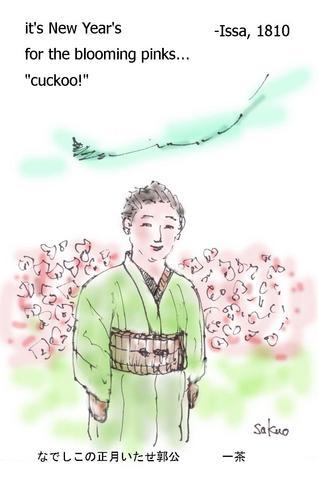
Haiga by Nakamura Sakuo
http://cat.xula.edu/issa/searchissa.php?haiku_id=338.09a
:::::::::::::::::::::::::::::::::::::::::::::::::::::::::::::::::::::::::::::::::::::::::::::::::::::
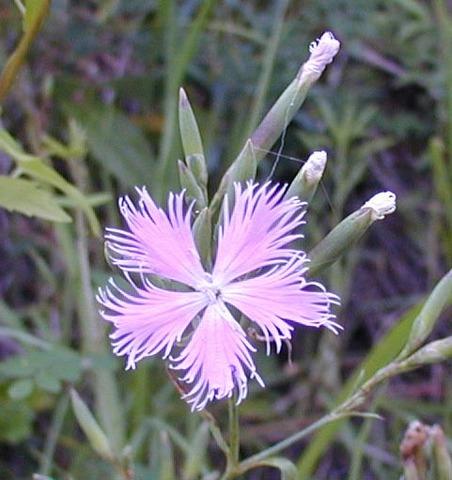
© Photos by Gabi Greve, 2005
:::::::::::::::::::::::::::::::::::::::::::::::::::::::::::::::::::::::::::::::::::::::::::::::::::::
hagi kikyo nadeshiko nando moe ni-keri
bush clover, bellflowers
and also pinks
have sprouted
Masaoka Shiki 正岡子規
http://www.ecf.or.jp/shiki/2000/sympo-e.html
:::::::::::::::::::::::::::::::::::::::::::::::::::::::::::::::::::::::::::::::::::::::::::::::::::::
Nadeshiko hokku by
. Matsuo Basho 松尾芭蕉 - Archives of the WKD .
撫子にかかる涙や楠の露
nadeshiko ni kakaru namida ya kusu no tsuyu
KUSU refers to the warrior Kusunoki Masashige 楠正成 (1294 - 1336).
Translation and MORE about
. Kusunoki Masashige 楠木正成 .
. Basho Hokku about Tears .
.............................................................................
撫子の暑さ忘るる野菊かな
nadeshiko no / atsusa wasururu / no-giku kana
霜の後撫子咲ける火桶哉
. shimo no nochi nadeshiko sakeru hioke kana .
酔うて寝ん撫子咲ける石の上
. youte nen nadeshiko sakeru ishi no ue .
yoote nen / yoote nenmu
. Matsuo Basho 松尾芭蕉 - Archives of the WKD .
:::::::::::::::::::::::::::::::::::::::::::::::::::::::::::::::::::::::::::::::::::::::::::::::::::::
かさねとは八重撫子の名なるべし
kasane to wa yae nadeshiko no na naru beshi
"Double"
must be another name
for "Eightfold Pink"
Sora, Oku no Hosomichi
Quote:
In Sora's poem, Nadeshiko, the pink, is the season word indicating summer. Although this flower is numbered among the seven grasses of autumn, in haikai it is considered to indicate summer.
Since ancient times there have been many examples in literature of children named
Nadeshiko; we see it used in The Tale of Genji in the "Broom Tree" chapter. Because this name is one of charm and beauty, Sora did not expect to find it in the rustic countryside, and consequently he took it to mean, "layered," a more commonplace word pronounced the same way.
Realizing his mistake, he combined the words to create "yae nadeshiko," the "layered pink." Although there is no such flower as the "layered pink," by using the poem to acknowledge his own mistake and correct it, Sora demonstrates his own sensibility. This notion of finding rude country people more esthetically senitive than expected
is a leitmotif throughout this work in particular and Japanese literature in general.
Evidently meeting this little girl named Kasane in such an auspicious way greatly affected Basho for the memory of the encounter stayed with him. He dscribes the meeting in other places besides this diary, and once, when a friend asked him to suggest a name for his newborn daughter, gave Kasane as his recommendation. On another occasion, Basho recalled this episode and told Sora that if he had had a little girl of his own, he would have named her Kasane.
Tr. Ad G. Blankestijn
Oku no Hosomichi - - - - Station 6 - Nasu 那須 - - -
. Matsuo Basho 松尾芭蕉 - Archives of the WKD .
*****************************
Related words
***** Rock Carnation, ganpi がんぴ岩菲
Thousand-handed rock carnation, senju ganpi 千手岩菲
It looks like a thousand-handed Kannon Bosatsu.
kigo for early summer
Lychnis gracillima
Country of origin is China. It looks very similar to the wild carnation (nadeshiko). It flowers in may and june, usually with white flowers. The petals are thinly lapped with deep cuts. These plants are a bit smaller than the wild carnation, but very tough and live in rough natural environments, especially in high mountain areas.
Click HERE to look at some photos !
:::::::::::::::::::::::::::::::::::::::::::::::::::::::::::::::::::::::::::::::::::::::::::::::::::::
***** Carnation (kaaneeshon カーネーション)
kigo for early summer
Carnation from Holland, oranda sekichiku おらんだ せきちく 和蘭石竹
.... oranda nadeshiko 和蘭撫子
Dianthus caryophyllus
This flower is the most common gift for Mother's Day. Its origin is South Europe and Western Asia.
Legend says that when Jesus was killed, his mother Maria cried and her tears fell on the ground, where the carnations would then start to grow. The most common colors are red and white.
Click HERE to look at some !
Mother’s Day
this year
the white carnation
Ellen Compton
http://www.theheronsnest.com/haiku/0803W1746/thn_issue.h8.html
***** Mother's Day
:::::::::::::::::::::::::::::::::::::::::::::::::::::::::::::::::::::::::::::::::::::::::::::::::::::
***** WKD : Seven Herbs of Autumn (aki no nanakusa)

© Photo Gabi Greve, Summer 2010
:::::::::::::::::::::::::::::::::::::::::::::::::::::::::::::::::::::::::::::::::::::::::::::::::::::
fukuro nadeshiko 袋撫子 (ふくろなでしこ )
***** Location: Japan
***** Season: Late Spring
***** Category: Plant
lit. "nadeshiko with a bag". Silene pendula, Nodding Catchfly
another name for oomantema おおまんてま

.................................................................................
kasumisoo 霞草 (かすみそう)
misty plant
mure nadeshiko 群撫子(むれなでしこ)"crowd of pinks"
kogome nadeshiko こごめなでしこ
Gipskraut
Gypsophila elegans. in pink, white etc.

:::::::::::::::::::::::::::::::::::::::::::::::::::::::::::::::::::::::::::::::::::::::::::::::::::::
[ . BACK to DARUMA MUSEUM TOP . ]
[ . BACK to WORLDKIGO . TOP . ]
- #nadeshiko -
:::::::::::::::::::::::::::::::::::::::::::::::::::::::::::::::::::::::::::::::::::::::::::::::::::::



 Posts
Posts


5 comments:
cool dawn ~
the nadeshiko field
sways in breeze
watered by tears-
a white carnation sprouts
near grandmom's grave
Although 'nadeshiko' most often refers to a child, it can also refer to an adult woman.
"She [haiku poet Hoshino Tsubaki] is a typical Yamato nadeshiko
(Dianthus superbus, flower known as the "pink", i.e. a graceful Japanese lady)."
http://www.worldhaikureview.org/3-1/haikulife1.shtml
Faubion Bowers, in a footnote to Issa's famous "nadeshiko" haiku
(nadeshiko no naze oreta zo yo oreta zo yo), says:
"The pink or daisy ('nadeshiko') is a delicate potted plant synbolic of Japanese virtue."
Earl Miner translates 'nadeshiko' as "maidenflower" in his translation of Basho's haiku, although there is another flower called maidenflower, 'ominaeshi', so I don't know if Miner's translation is justified.
Larry
http://groups.yahoo.com/group/cherrypoetryclub/message/32495
オルガンはバッハなりけり思草
orugan wa bahha narikeri omoigusa
organ music
is Bach
broomrapes
星野麥丘人 Bakukyuujin Hoshino
Tr. Fay Aoyagi
Matsuo Basho
霜の後撫子咲ける火桶哉
shimo no nochi nadeshiko sakeru hioke kana
MORE
about hibachi braziers
Post a Comment