:::::::::::::::::::::::::::::::::::::::::::::::::::::::::::::::::::::::::::::::::::::::::::::::::::::
Explanation
There is a special card game in Japan called
"Flower Trump", hanafuda 花札 or
hana karuta 花カルタ 花かるた, 花がるた.
.. .. .. Karuta, Uta Karuta 歌留多
kigo for the New Year.
In Karuta, the descriptions are taken from old poems.
See ... Hyakunin Isshuu <> One hundred poems and links
. WKD : Ogura Hyakunin Isshu Poems 百人一首 .
Read them all HERE: (External Link)
A Hundred Verses from Old Japan
translated by William N. Porter [1909]
:::::::::::::::::::::::::::::::::::::::::::::::::::::::::::::::::::::::::::::::::::::::::::::::::::::
These cards feature flowers of the four seasons
within the 12 months of a year.

source - mansonge/mjf/mjf-28.html
There are 48 cards in a hanafuda deck, organized in 12 suits of 4 cards each. Each suit corresponds to a month of the year. There are 4 kinds of card: 'lights' worth 20 points, 'animals' worth 10 points (also including the sake cup and bridge cards), 'poetry slips' worth 5 points, and 'dregs' worth 1 point. There are 5 lights, 9 animals, 10 slips, and 24 dregs in one deck.
Each suit generally consists of 1 light or animal card, 1 poetry slip, and 2 dregs.
http://hana.kirisame.org/cards.html
Games played with these flower cards
Flower cards probably originated in Japan are used in Japan, Korea and Hawaii, usually for games of the fishing group. At the start of the game, some cards are face up on the table, half of the remaining cards are dealt out to the players and the rest are in a face down stock. For example, with three players you would begin with 6 cards face up, 7 in the hand of each player and a stock of 21. At your turn you play a card from your hand, and if it matches a face-up card (being the same month), you capture both cards.
Then you turn over the top card of the stock, and again if this matches a face-up card you capture both cards. If either the card you play or the card you turn up from the stock does not match anything, it is left face up on the table to be captured in future. In some games the lone 1-point card of the November/Willow/Rain suit (known as Gaji or Onifuda or lightning) can be used as a wild card to match any other card.
http://www.pagat.com/class/flower.html
:::::::::::::::::::::::::::::::::::::::::::::::::::::::::::::::::::::::::::::::::::::::::::::::::::::
January :
Pine and Crane, Matsu ni Tsuru 松に鶴
Pine (matsu, Japan)
Crane and Turtle By Gabi Greve
February :
Plum and Nightingale, Ume ni Uguisu 梅に鶯
Plum blossom (ume) Japan
March :
Curtain and Cherry Blossoms, Sakura ni Maku 桜に幕
Cherry Blossoms (sakura, Japan)
April :
Cuckoo and Wisteria, Fuji ni Kakko 藤にカッコウ
May :
Eight-board Bridge and Iris, Yastuhashi to Kakitsubata 八橋と杜若
Kakitsubata

http://happyhaiku.blogspot.com/2005/06/summer-iris.html
June :
Butterfies and Peony, Botan ni Choo 牡丹に蝶
Peony (botan, Japan
Butterfly
July :
Wid Boar and Bush Clover, Hagi ni Inoshishi 萩にいのしし
August :
Moon and Pampass Grass, Susuki ni Tsuki ススキに月
.. .. .. .. MOON and its LINKS
September :
Sake Cup and Crysanthemum, Kiku ni Sakazuki 菊に杯
Chrysanthemum
October :
Deer and Maple, Momiji ni Shika もみじに鹿
Leaf Watching
November :
Ono no Tofu and Willow, Yanagi ni Ono No Toofuu 柳
 Ono no Doofuu
小野道風(894-966)
a famous calligrapher during Heian Period, who had watched a frog trying to climb a tree and got a hint from this to practise diligently himself. He finally became one of the three famous calligraphers of his time together with Fujiwara no Sukemasa and Fujiwara no Yukinari.
In the DARUMA Magazine 1995 you find a picture of a plate with Ono no Dofu sitting at a pond watching a frog.
December :
Phoenix and Paulownia, Kiri ni Hooh 桐に鳳凰
Phoenix in Asian Art By Gabi Greve
xxxxxxxxxxxxxxxxxxxxxxxxxxxxxxxxxx
Some English Links
http://www.cs.wisc.edu/~johnbent/hanahuda/
Beautiful old cards
http://www.hana300.com/aafuda.html
Symbolism in the Hanafuda Cards
source : hanafudahawaii.com/gsymbols.html
:::::::::::::::::::::::::::::::::::::::::::::::::::::::::::::::::::::::::::::::::::::::::::::::::::::

rongo karuta 論語カルタ Confucius Analects as karuta
rongo iroha karuta
. Confucius .
*****************************
Things found on the way
Link to Flowers and Haiku in Japanese
花を詠んだ俳句・短歌
http://www.hana300.com/aahaiku.html
Comparison of monthly flowers from past and present Japan and China.
花暦(はなごよみ)
http://koyomi.vis.ne.jp/directjp.cgi?http://koyomi.vis.ne.jp/reki_doc/doc_0850.htm
:::::::::::::::::::::::::::::::::::::::::::::::::::::::::::::::::::::::::::::::::::::::::::::::::::::
HAIKU KARUTA 俳句かるた / 俳句カルタ
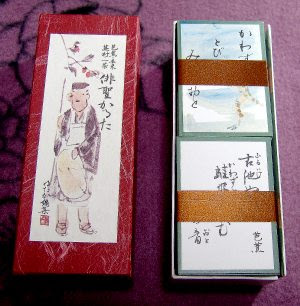
49 Haiku from Basho, Issa, Buson, Kyorai and others


Basho : Oku no Hosomichi 奥の細道かるた
-----


一茶俳句カルタ
Issa Haiku Karuta

高濱虚子小諸俳句カルタ
Takahama Kyoshi Haiku Karuta

正風 俳句かるた
Shoofuu, Shofu Karuta

子ども俳句かるた
For Children to study Chinese characters

俳句いろはかるた / 俳句いろはカルタ
Haiku with the Japanese alphabet, I.RO.HA
動物俳句かるた
Haiku Karuta with animals
. . . CLICK here for Photos !
and many more ...
. . . CLICK here for HAIKU KARUTA Photos !
WASHOKU
Japanese Food and Card Games
:::::::::::::::::::::::::::::::::::::::::::::::::::::::::::::::::::::::::::::::::::::::::::::::::::::
Jomo Karuta Game from Gunma Prefecture
上毛かるた(じょうもうかるた)
with a Daruma card!

My Details are HERE:
Jomo Karuta (Joomoo Karuta)
Moriya Furusato Karuta ... 守谷のふるさとかるた
Another set of local cards with senryu of Moriya Town.
*****************************
HAIKU
狸汁花札の空月真赤
tanuki jiru hanafuda no sora tsuki makka
badger soup -
in the sky of the flower trump
the moon so red
http://www.longtail.co.jp/~fmmitaka/199812.html
If you look closely, there is no RED MOON on the cards of this game, only a red sky around the moon.

http://www.hana300.com/aafuda.html
:::::::::::::::::::::::::::::::::::::::::::::::::::::::::::::::::::::::::::::::::::::::::::::::::::::
花札をやり過ぎ初夢猪鹿蝶
hanafuda o yarisugi hatsuyume i shi cho
playing too much flower trump -
in my first dream of the year
only wild boar, deer and butterflies
http://www.melma.com/mag/49/m00023049/a00000947.html
:::::::::::::::::::::::::::::::::::::::::::::::::::::::::::::::::::::::::::::::::::::::::::::::::::::

source : poetsohya.blog81.fc2.com
The priest-poet here is Shune Hooshi (Shun-e Hoshi) 俊恵法師.
法師出て嫌はるるなり歌がるた
hooshi dete kirawaruru nari utagaruta
the priest-poet came up -
I hate it, I hate it, this
poetry trump
. Awano Seiho 阿波野青畝
In the Ogura Hyakunin Isshu card game, there are quite a few hooshi 法師 priests.
Sometimes a special game is played, the "boozu meguri 坊主めくり". If you draw the card of one of the priests, you have to perform some spacial tricks or have your face painted black with ink. That is why the hooshi - boozu card is not well liked.
. WKD : Ogura Hyakunin Isshu - .

In the Hanafuda game, the card for August is the boozu 坊主. the full moon like the shaven head of a priest, and the susuki pampas grass.
:::::::::::::::::::::::::::::::::::::::::::::::::::::::::::::::::::::::::::::::::::::::::::::::::::::
なぐさみのはっちはっちや秋日和
nagusami no hatchi-hatchi ya akibiyori
for the fun of it
we play "eighty eight" -
fine day in autumn
Kobayashi Issa
hachihachi, hachi-hachi はちはち【八八】
a hanafuda card came. With more than 88 points you win. It is played 12 times before a win is taken.
also called hachi はち 8, or hachijuuhachi はちじゅうはち 88.
Reference and rules of Hachi-Hachi
:::::::::::::::::::::::::::::::::::::::::::::::::::::::::::::::::::::::::::::::::::::::::::::::::::::
Uta Karuta 歌留多
traditional Japanese playing cards (for poem word games)

歌かるた無言の人の上手かな
uta karuta mugon no hito no joozu kana
playing karuta ...
without saying a word
he plays so well
Horiguchi Seimin 堀口星眠
Tr. Gabi Greve
:::::::::::::::::::::::::::::::::::::::::::::::::::::::::::::::::::::::::::::::::::::::::::::::::::::
uta karuta hitotsu no uta ga waga me hiku
half-poems spread on tatami --
of one-hundred cards
one attracts my eyes
Hashimoto Takako, trans. Eiko Yachimoto
:::::::::::::::::::::::::::::::::::::::::::::::::::::::::::::::::::::::::::::::::::::::::::::::::::::
the letter TSU つ
the first word of the poem must start with this letter.

tsukiyo kara umareshi kage o aishikeri
I do love
the shadow that is born
from moonlight
三橋敏雄俳句 Mitsuhashi Toshio Haiku Karuta
Tr. Gabi Greve
*****************************
Related words
Twelve- Month Poem Series on Flowers and Birds
by Fujiwara no Teika 藤原定家
. Flower and Bird pairs in Waka .
:::::::::::::::::::::::::::::::::::::::::::::::::::::::::::::::::::::::::::::::::::::::::::::::::::::::

karuta, sugoroku - games for New Year
『カルタ・すごろく~お正月の紙遊び~』
紙の博物館
- 紙の博物館 - Paper Museum -
In the third line on the left you can even see Daruma san.
:::::::::::::::::::::::::::::::::::::::::::::::::::::::::::::::::::::::::::::::::::::::::::::::::::::::
yookai karuta 妖怪カルタ Yokai monster Karuta

CLICK for many more samples !
. Edo Yookai Karuta 江戸妖怪かるた
Edo Yokai monsters card game .
. - yookai, yōkai 妖怪 Yokai monsters - .

- Yokai Hanafuda by
- Shigeru Mizuki (水木しげる, Mizuki Shigeru) -
:::::::::::::::::::::::::::::::::::::::::::::::::::::::::::::::::::::::::::::::::::::::::::::::::::::::
Tengu hanafuda 天狗花札 Tengu Playing Cards

京都大石天狗堂 - 任天堂 Nintendo 1889
. kanban to tengu 天狗と看板 shop signs with Tengu .
hanakaruta 花かるた 鼻かるた - 大石天狗堂
. Tengupedia - 天狗ペディア - Tengu ABC-List .
:::::::::::::::::::::::::::::::::::::::::::::::::::::::::::::::::::::::::::::::::::::::::::::::::::::::

hanafuda dorei 花札土鈴 clay bells with Hanafuda motives
. dorei どれい【土鈴】 clay bells .
:::::::::::::::::::::::::::::::::::::::::::::::::::::::::::::::::::::::::::::::::::::::::::::::::::::::
. Daruma Karuta だるまカルタ .
Zen teachings 禅語かるた「だるま」
[ . BACK to WORLDKIGO . TOP . ]
[ . BACK to DARUMA MUSEUM TOP . ]
- #karuta #hanafuda -
:::::::::::::::::::::::::::::::::::::::::::::::::::::::::::::::::::::::::::::::::::::::::::::::::::::



 Posts
Posts


11 comments:
we play that here in Hawaii too
my lady friend likes to slap those cards down and they make big noise..
she has earings that are the 20 point cards...
aloha
S.
Here are some Card Haiku from
Geert Verbeke.
http://tinyurl.com/d462v
on the sideboard
the winners and losers
so many photos
.........................
Thank you, Geert !
.
Gambling (bakuchi) and Haiku
::::::::::::::::::::::::::::::::::::::::::::::::::::::::::::::::::::::
Thank you for sharing precious hanafuda information.
sakuo.
haiku cards
someone else turns
my verses!
haiku cards ...
I hope to get the ones
with the flowers
:>) Ella Wagemakers
New Translation
One Hundred Poets, One Poem Each: A Translation of the Ogura Hyakunin Isshu
Peter McMillan; with a foreword by Donald Keene
Compiled in the thirteenth century, the Ogura Hyakunin Isshu is one of Japan's most quoted and illustrated works, as influential to the development of Japanese literary traditions as The Tale of Genji and The Tales of Ise. The text is an anthology of one hundred waka poems, each written by a different poet from the seventh century to the middle of the thirteenth, which is when Fujiwara no Teika, a renowned poet and scholar, assembled and edited the collection.
The book features poems by high-ranking court officials and members of the imperial family, and each is composed in the waka form of five lines with five syllables in the first and third lines and seven syllables in the second, fourth, and fifth (waka is a precursor of haiku). Despite their similarity in composition, these poems evoke a wide range of emotions and imagery, and touch on themes as varied as frost settling on a bridge of magpie wings to the continuity of the imperial line.
Though the Ogura Hyakunin Isshu has been translated into English before, many scholars and other translators have struggled with the formality of the original text, often padding lines in order to conform to the original syllabic model or rearranging the poems to create unnecessary rhyme. In this bold new translation, Peter McMillan uses only the words that are necessary to evoke the original sensations these poems once gave their readers. The poems are accompanied by calligraphic versions in Japanese and line drawings of the individual poets.
Explanatory notes place the poems in context, and an appendix includes both the poems' Japanese typed and romanized versions. The Ogura Hyakunin Isshu is an excellent introduction to Japan and its special lyric tradition.
http://cup.columbia.edu/book/978-0-231-14398-1/one-hundred-poets-one-poem-each
The enduring tradition of tanka
By DAVID BURLEIGH
HYAKUNIN ISSHU, introduced by Mutsuo Takahashi, translated by Emiko Miyashita and Michael Dylan Welch.
WHITE PETALS by Harue Aoki.
The hefty bilingual edition of the classic poetry collection "Hyakunin Isshu" has a nonce subtitle on the inside: "100 Poets: Passions of the Imperial Court." The rationale informing the passionate lives of emperors and court officials is described in a helpful introduction by the distinguished modern poet Mutsuo Takahashi, who sets this work on a par with "The Tale of Genji."
Consider, though, how extraordinary it is that all the poems take the same form precisely: the 31 syllables (5-7-5-7-7) of the tanka, or waka, as it was originally known. This short, evidently representative collection "spans more than five hundred years," while the form itself has been around for more than a thousand, and is still widely used today. This is hardly thinkable in a Western context, where few literary traditions stretch back quite that far, especially in the same language.
The 100 poems, one each from 100 poets, were selected by Fujiwara no Teika (1162-1241), originally to decorate some screen doors. More properly called the "Ogura Hyakunin Isshu," the anthology became the basis for a card game played at New Year, for which the poems must be learned by heart. And the heart is deeply involved in the contents, for this, says Takahashi, is an "anthology of love" besides being a "great funeral march" for a lost age.
Chosen from a wide range of work and arranged throughout in pairs, the poems are not just representative but constitute the cream of classic composition in this form. Needless to say, there have been numerous versions of it done before in English, including an early rhyming one by William N. Porter, which is still in print. The present translators adopt a fairly plain approach:
a boatman
crossing Yura Strait
has lost his rudder . . .
so, too, the passage of my love
knows no destination
Sometimes one can recognize a personality, such as the arch author of a Heian pillow-book, Sei Shonagon:
while it is yet dark,
your crowing like a rooster
may deceive some folks,
but not Meeting Hill's gate guards
who still will bar your passage
The exchange of poems was part of the whole courtship process, and parting at dawn is one of its regular themes, here given an amusing turn. Other notable features of the collection, apart from its emotional regrets, are the autumnal flavor, and the prevalence of the color white. The whiteness has many meanings, including seasonal references to snow and dew or even cherry blossoms, while it is also the color of autumn on the classic spectrum inherited from China.
Each poem has a four-page format, the last page carrying an illustration. There are no people in any of the photographs, the mood conveyed instead by a natural surface or scene. One only has a pair of birds in the distance, another two sticks swirling in white water, the barest hint of emotional entanglements. Takahashi provides a brief prose commentary on each poem, explaining the content but, unlike the introduction, this is not translated.
The aesthetic of this volume comes right down to the present age, to the writings, for example, of the novelist Yasunari Kawabata, the source of which is recognizable here:
the autumn wind blows
from the mountains of Yoshino
deep into the night —
as the ancient capital grows colder
the villagers beat fabric into softness
There is even a reference in one later poem to "tangled hair" (midaregami), the title of a famous volume of tanka by Akiko Yosano at the beginning of the 20th century. Kaoru Yosano, a grandson of the author, is currently minister of finance. But more remarkable than faint echoes in the corridors of power is the fact that the tanka remains in use among living poets.
Japan Times, May 2009
Hey Gabi...
This is really cool!!! Thanks a bunch for sharing......
D.BB>
Gabi san! I didn't know there are so many Karuta.
I have never seen Issa Karuta and others.
Benkyo ni narimasu ...... ^ ^
T.
Kumamoto, Hitoyoshi town
unsun karuta ウンスンかるた Unsun card game
The name, Unsun, is said to have derived from the Portuguese words for the number one – “un” and the best – “sun”.
.
http://omamorifromjapan.blogspot.jp/2011/08/kumamoto-folk-toys.html
toto awase 魚魚あわせ fish card memory game
toto karuta 魚魚かるた
.
http://omamorifromjapan.blogspot.jp/2011/07/koi-carp.html
.
Post a Comment