:::::::::::::::::::::::::::::::::::::::::::::::::::::::::::::::::::::::::::::::::::::::::::::::::::::
. Yellow Mountain Rose (yamabuki 山吹) .
Kerria japonica
:::::::::::::::::::::::::::::::::::::::::::::::::::::::::::::::::::::::::::::::::::::::::::::::::::::
The color YELLOW and haiku
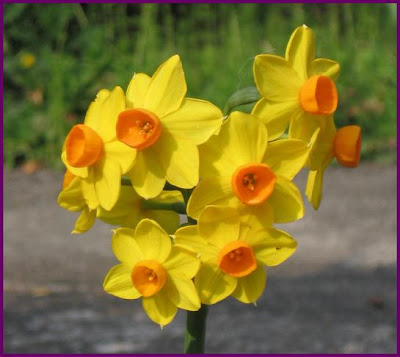
spring sunshine -
challenging my concept of
Y E L L O W
- Gabi Greve, Spring 2007 -
The group of colors with a shade of yellow are often called
oodoiro, oodo iro 黄土色 "yellow earth color"
#c39143
In ancient China it was a well-respected color, used for the tiles of the Emperor's palace and not allowed for the common folk.
By the time of Prince Shotoku in Japan, there were two extremes, dark yellow 濃黄 and light yellow 薄黄 whith various shades inbetween.
Around 650, it had become a color for the robes of the common people. Plants for dyeing yellow cloth were plenty and it was nothing special.
kariyasu 刈安 (Miscanthus tinctorius #f5e56b) , kuchinashi 梔子 (gardenia #fbca4d 支子色), kihada 黄蘗 (Phellodendron amurense #fef263)plants.
Kihada was also used to color paper for copying sutras or other texts.
.................................................................................
Check out the Japanese color codes and samples of YELLOW
kiiro, ki-iro 黄色きいろ yellow - #ffd900
中黄ちゅうき
緑黄色りょくおうしょく
金色こんじき
and so on, too many to list them all here.
source : www.colordic.org
Shades of Yellow - Sunshine
These words are synonymous with or represent various shades of the color yellow: banana, cadmium yellow, chartreuse, chiffon, cream, golden, goldenrod, khaki, lemon, mellow yellow, saffron, topaz, yellow ocher.
- Reference :yellow color symbolism -
:::::::::::::::::::::::::::::::::::::::::::::::::::::::::::::::::::::::::::::::::::::::::::::::::::::
- - - - - kigo using YELLOW 黄 ki
. yellow sand 黄砂 (こうさ) koosa .
. "yellow sparrow wind" 黄雀風 koojakufuu.
. yellow conch trumpet plant 黄つりふね ki tsurifune .
. yellow plum blossom 黄梅 oobai .
Jasminum nudiflorum
. yellow cockscomb 黄鶏頭 kikeitoo .
. yellow chrysanthemum 黄菊 kigiku .
. Spring flowers with 黄 yellow .
. yellow (leaves) falling, kooraku 黄落 (こうらく) .
."yellow fish" nishin 黄魚(にしん)herring .
. "yellow horse fish" 黄鯛魚 watako .
. yellowtail 鰤 buri .
Seriola quinqueradiata
. yellow sea bream 黄鯛 kidai .
more sea bream with YELLOW 黄
. yellow gadfly 黄虻 kiabu, ki-abu .
. yellow bee 黄蜂 kibachi .
. yellow ant 黄蟻 kiari, ki-ari .
. yellow butterfly 黄蝶 kichoo .
monkichoo 紋黄蝶
asagi madara 浅黄斑蝶
. yellow (silkworm) cocoon 黄繭 kimayu .
. yellow sparrow, baby sparrow 黄雀 ki suzume .
. Narcissus flycatcher 黄鶲 kibitaki .
Ficedula narcissina
. Golden Week 黄金週間 oogon shuukan .
. yellow linen kimono 黄帷子 kibira .
and many more . . .
.................................................................................
- - - - - topics using YELLOW
. yomi 黄泉 "the yellow springs" .
meido めいど【冥土 / 冥途】 the Netherworld, nether world
the world of the dead, the other world
. Yellow Fudo, Ki Fudo 黄不動明王 .
Fudo Myo-O with Yellow Eyes, Meki Fudo 目黄不動
***** . Colors used in Haiku .
*****************************
Things found on the way

-- - Yellow Daruma Dolls - - -
*****************************
HAIKU

There is an animal
ko-oo, kichoo 黄鶯 "yellow uguisu" コウライウグイス
koorai uguisu 高麗鶯 Oriolus chinensis
kinakodori 黄粉鳥(きなこどり)uguisu with the color of kinako, soy bean powder
Haiku by Issa with a "yellow voice"
鶯や黄色な声で親をよぶ
uguisu ya kiiro na koe de oya o yobu
nightingale--
with a shrill voice
calling mother
Tr. David Lanoue
The young uguisu
Calls its parents
With a yellow voice.
Tr. Blyth
the Bush Warbler
with a yellow voice/call
calls for its parents
Japanese English: Language and Culture Contact
source : James Stanlaw
The youngest nightingale that can rejoice
calls to its parents in a yellow voice.
Issa must have been in deep meditation and he heard the nightingale rejoicing and calling to its parents in a yellow voice.
Issa is saying something about his silence. When you are in silence and a cuckoo from the bamboos starts singing, it deepens your silence.
source : shiromani

The Japanese expression is "yellow voice"
kiiro na koe きいろな[=の] 声(こえ)- kiiroi koe きいろい(黄色)声
kiiroi koe 黄色い声 "a yellow voice"
the shrill high-pitched voice of a small girl child, sounding something like
kiikii キイキイ in Japanese.
The Chinese character 黄 also has the faint meaning of
"a child 子ども" with a high-piched voice.
During the Edo period it was fashionable to compare the voice with a color, from white to the goshiki, five colors 5色の声.
kowairo 声色(こわいろ) the color of a voice
neiro 音色 (ねいろ) the pitch of a color
In ancient China yellow was already a symbol of alert.
. Voices of animals in haiku .
.................................................................................
Synesthesia
(also spelled synæsthesia or synaesthesia, plural synesthesiae or synaesthesiae), from the ancient Greek σύν (syn), "together," and αἴσθησις (aisthēsis), "sensation," is a neurological condition in which stimulation of one sensory or cognitive pathway leads to automatic, involuntary experiences in a second sensory or cognitive pathway.
Sound → color synesthesia
According to Richard Cytowic, sound → color synesthesia is "something like fireworks": voice, music, and assorted environmental sounds such as clattering dishes or dog barks trigger color and firework shapes that arise, move around, and then fade when the sound ends. For some, the stimulus type is limited (e.g., music only, or even just a specific musical key); for others, a wide variety of sounds triggers synesthesia.
Sound often changes the perceived hue, brightness, scintillation, and directional movement. Some individuals see music on a "screen" in front of their faces. Deni Simon, for whom music produces waving lines "like oscilloscope configurations—lines moving in color, often metallic with height, width and, most importantly, depth. My favorite music has lines that extend horizontally beyond the 'screen' area."
Individuals rarely agree on what color a given sound is (composers Liszt and Rimsky-Korsakov famously disagreed on the colors of music keys); however, synesthetes show the same trends as non-synesthetes do. For example, both groups say that loud tones are brighter than soft tones, and that lower tones are darker than higher tones. Synaesthetes nevertheless choose more precise colours than non-synesthetes and are more consistent in their choice of colours given a set of sounds of varying pitch, timbre and composition.
© More in the WIKIPEDIA !
.................................................................................
quote
禁男の園の夏至光紺また黄
kindan no sono no geshikoo kon mata ki
in the male-forbidden school
the summer solstice light is
deep blue and yellow
平畑静塔 Seitoh Hirahata
Fay’s Note: The poet plays with the letter “dan.” Usually, “ 断” (dan: forbid) is used for the word, but he uses “男” (dan: male) instead. With a character meaning “forbid,” the word “kindan-no-sono” is “a garden with the forbidden fruits”.
Japanese school uniform is usually in deep-blue color. Is“yellow” he saw the color of ribbons on the female students?
Or does he want us think about the young girls’ high-pitched voices , “kiiroi koe” (literally translation: yellow voice)?
source : Fay Aoyagi
:::::::::::::::::::::::::::::::::::::::::::::::::::::::::::::::::::::::::::::::::::::::::::::::::::::
Japanese haiku with a "yellow voice", the voice of small girls:
夕立や走る赤傘黄色声
連翹を抜けて黄色の風になる
source : www.gendaihaiku.gr.jp
夏台風黒雲払う黄色声
source : ichinichi ikku
キンセイ花黄色い声で大合唱
source : machikado
空元気闇汁血色黄色声
のぶべい
source : teacup.com
黄色声心頭滅却寒灸
一路
source : teacup.com
:::::::::::::::::::::::::::::::::::::::::::::::::::::::::::::::::::::::::::::::::::::::::::::::::::::
haiku with YELLOW, compiled by Larry Bole
2 hailku by BUSON
teshoku shite iro ushinaeru kigiku kana
The yellow chrysanthemums
Lose their color
In the light of the hand-lantern,
Tr. Blyth

cha no hana ya shiro ni mo ki ni mo obotsukana
Tea-flowers;
Are they white?
Are they yellow?
Tr. Blyth
The tea-plant flowers --
whether white or whether yellow,
hard to tell.
Tr. Sawa & Shiffert
. WKD : Yosa Buson 与謝蕪村 in Edo .
.................................................................................
yamabuki no utsurite ki naru izumi kana
Catching the reflection
Of the yamabuki,
The spring is yellow.
Ransetsu
Tr. Blyth
. Yellow Mountain Rose (yamabuki 山吹) .
Kerria japonica
:::::::::::::::::::::::::::::::::::::::::::::::::::::::::::::::::::::::::::::::::::::::::::::::::::::
since olden times,
the yellow voice of spring -
narcissus
- Shared by Gennady Nov -
Joys of Japan, 2012
:::::::::::::::::::::::::::::::::::::::::::::::::::::::::::::::::::::::::::::::::::::::::::::::::::::
the wind carries
a yellow cloud over
the rape flowers field
Heike Gewi
kigo hotline
*****************************
Related words
***** . PLANTS in all seasons . . . SAIJIKI
***** . Colors used in Haiku .
:::::::::::::::::::::::::::::::::::::::::::::::::::::::::::::::::::::::::::::::::::::::::::::::::::::
[ . BACK to DARUMA MUSEUM TOP . ]
[ . BACK to WORLDKIGO . TOP . ]
- #yellow #yellowhaiku #yamabuki -
:::::::::::::::::::::::::::::::::::::::::::::::::::::::::::::::::::::::::::::::::::::::::::::::::::::



 Posts
Posts


2 comments:
yellow Daruma
the money saver
in her bedroom
the rich colouring
of yellow mountain roses
around sunset
Geert Verbeke
hatsu-choh ku nani-iro to tou ki to kotau
The first butterfly has come.
Asked for its color
I answered yellow.
--Kyoshi, Tr. Katsuya Hiromoto
hinawari-no mae-no masuto mo ki nari-keri
Beyond a garden
of sunflowers, the mast of a boat
is yellow too.
---Shuuooshi, Shuoshi Tr. Ueda
aki no choo ikete-iru ki wa mottomo ki
The living yellow
of the autumn butterfly---
yellow above all!
--Seishi, Tr. Kodaira and Marks
.
Post a Comment