:::::::::::::::::::::::::::::::::::::::::::::::::::::::::::::::::::::::::::::::::::::::::::::::::::::
Wolf, Japanese Wolf (ookami 狼)
***** Location: Japan
***** Season: All Winter
***** Category: Animal
*****************************
Explanation
The wolf has been living in Japan for a long time, but now it is extinct, even in Hokkaido. The wolf has smaller ears than a dog, but his teeth are stronger. Since he was feared during all seasons, his name was "the Great God" ookami 大神、later the Chinese character changed to 狼.
Other kigo names for this animal:
mountain dog, yama-inu, yamainu 山犬、豺
Wolf of Ezo, Ezo ookami 蝦夷狼
..... Ezo is the old name of Hokkaido.
. Hayataro, Shippeitaro, the strong Mountain Dog .
and the Hihi (狒々, 狒狒 or 比々) Baboon Monkey Monster
. ookami 狼 Okami, wolf legends .
- Introduction -
:::::::::::::::::::::::::::::::::::::::::::::::::::::::::::::::::::::::::::::::::::::::::::::::::::::
Honshu Wolf (Canis lupus hodophilax)which occupied the islands of Honshu, Shikoku, and Kyushu in Japan.
The last known specimen died in 1905, in Nara Prefecture.
Ezo Wolf (Canis lupus hattai), the Hokkaido Wolf.
The Ezo Wolf became extinct in 1889.
http://www.answers.com/topic/japanese-wolf
xxxxxxxxxxxxxxxxxxxxxxxxxxxxx
ONCE THERE WERE WOLVES
Shrines are no salve when it comes to extinctions
By ROWAN HOOPER
There were two subspecies, the Hokkaido wolf, and the smaller Honshu wolf (like the two bear species still living in Japan today, the animals living in Hokkaido needed to be bigger because of the harsher climate). Both were distinct from wolves in Europe and North America; the Honshu wolf, only about 30 cm tall at the shoulder, was the smallest known variety of wolf.
In former times, wolves were revered and respected. They were seen by farmers as guardians of their crops. It was believed that wolves kept deer, hares and wild boars from causing damage to farmland. The Heian Period warlord ruler of northeastern Honshu, Fujiwara no Hidehira (1096-1187), was said to have been raised by wolves, like Romulus and Remus, the founders of Rome.
In Yamanashi Prefecture, offerings of azuki bean rice were left for wolves when cubs were born. It was sometimes believed that the tradition, known as inu no ubumimai, would be reciprocated by the wolf when a human child was born.
Read the rest here:
Wolves, Ookami, By ROWAN HOOPER
xxxxxxxxxxxxxxxxxxxxxxxxxxxxx
Woodblock Print by Kayama Matazoo
加山又造 狼
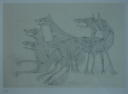
http://www.444009.jp/interiahangatokkaseiru.htm
xxxxxxxxxxxxxxxxxxxxxxxxxxxxx
JAPANESE WOLF FOLKLORE
by U.A. Casal
In the role of divine messenger, the wolf watches over mountains and forests. He sees to it that there is no undue cutting of trees or careless fire which may start a mountain conflagration, as also that there be no pollution of those little sanctuaries which are found all over a mountain.
Read this very interesting essay here:
JAPANESE WOLF FOLKLORE. by U.A. Casal
xxxxxxxxxxxxxxxxxxxxxxxxxxxxx
Mitsumine Shrine (Mitsumine Jinja) is famous for its wolf cult.

There is a talisman print of the Wolf Deity from this shrine.
This for a wolf that accompanies the hunter home from the mountain and then gets a morcel to eat. (okuri ookami)

http://www.kitanippon.co.jp/pub/hensyu/chinmoku/maboroshi/050112.html
Okuri ookami, the wolf seeing you home
.... An extension of this semantic affinity of the wolf with the dog is the image (in myth and legend) as a protector of mankind -- a sort of banken (watchdog) in the mountains. This watchdog role appears in the benign okuri-okami (sending wolf) stories. "When someone is walking along mountain roads at night sometimes a wolf follows without doing anything. On nearing the house the wolf disappears."
Sometimes the ubiquitous okuri-okami tales also mention the danger of looking back or falling over while being followed by the wolf, acts that may invite the wolf to attack....Nonetheless, what is usually stressed is that the wolf's purpose is not to prey but to protect, to see the lonely human being safely home through the dangerous night-time mountains.... Even today many villagers claim to have had such experiences in their youth....
© Copyright 2004 Wolf Song of Alaska.
Read a lot more about Japanese wolves:
http://www.wolfsongalaska.org/Wolves_Japan_on_extct.htm
My Essay about Japanese Wolf Worship
....... at Mitsumine Shrine Mitsumine Jinja 三峰神社
*****************************
Worldwide use
Alaska
Wolves and Religion
The Role of Fox, Lynx and Wolf in Mythology
Meaning Wolf
Wolves and the Christian Church
Beware of Wolves
Wolves and Christianity
Wolves and Early Saints
© Copyright Wolf Song of Alaska.
http://www.wolfsongalaska.org/wolves_and_religion_menu.html
:::::::::::::::::::::::::::::::::::::::::::::::::::::::::::::::::::::::::::::::::::::::::::::::::::::::
Ireland
The Irish Wolfhound (Irish: Cú Faoi)
is a breed of domestic dog (Canis lupus familiaris), specifically a sighthound. The name originates from its purpose (wolf hunting with dogs) rather than from its appearance.
Irish Wolfhounds are the tallest of dog breeds.
© More in the WIKIPEDIA !
cú faoil...
keeping the wolves
from the door
- Shared by John Byrne -
Haiku Culture Magazine, 2013
*****************************
Things found on the way
One evening an old Cherokee told his grandson
about a battle that goes on inside of all of us.
He said, "My son, the battle is between two wolves.
Read the story here:
feeding two wolves
or feeding just one ...
your haiku life
*****************************
HAIKU
- - - - - Kobayashi Issa -
狼の糞を見てより草寒し
ookami no kuso o mite yori kusa samushi
seeing wolf shit
these weeds feel
even more cold
- - - - -
山犬や鳴口からも霧の立
yama inu ya naku kuchi kara mo kiri no tatsu
mist rising even
from the gray wolf's
howling mouth
Tr. Chris Drake
This autumn hokku is from the seventh month (August) of 1823, when Issa was in his hometown. Before they became extinct in 1905, small gray wolves (Canis lupus hodophilax), called "Japanese wolves" (nihon ookami) in Japan and "Honshu wolves" elsewhere, were once common around Japan. In the hokku Issa refers to the wolf using the colloquial name "mountain dog," a name related to the wolf's size. Issa seems to be standing fairly close to the wolf, yet he doesn't seem to be afraid of it. He may share the common view in village Japan that wolves, like monkeys, are helpers and messengers of the mountain god and are benefactors of humans who are not to be feared or attacked.
Several Shinto shrines are devoted to the wolf god Ma-kami, "True God," and according to a widely believed folk etymology the word wolf (ookami) goes back to another ookami meaning "great god." In Japanese folktales wolves often walk along behind villagers, protecting them when they travel in the mountains. Female wolves were especially revered because of their fecundity, and they were commonly believed to ensure fertility among village women and good crops in the fields. In some areas, villagers even presented special dishes of rice with red beans in them -- dishes usually made to celebrate human births -- to the local mountain god shrine if it was discovered that a wolf mother near the village had given birth. Although gray wolves normally didn't attack humans, they did prey on deer, wild boars, raccoons, and other animals that like to ravage village fields, and so they were regarded as important allies of farmers.
The hokku is implicitly as much about thick mist rising up in an area apparently on or near a mountain or hill as it is about the wolf. The comparison of rising mist to breath suggests that the whole mountain and the area around it are alive and breathing, and Issa is impressed by the way the wolf and mountain seem to be closely connected and part of the same great living system. Issa does not explicitly say the mountain god is howling through the wolf, but he seems to be implying that the wolf and the mountain are both speaking the same mist-language, a language most humans are not able to speak fluently. This haiku may be both a salute to the wolf and mountain and an expression of thanks to them for their help in supporting human life in the high Shinano plateau, where Issa's hometown is located.
Chris Drake
. Kobayashi Issa 小林一茶 in Edo .
:::::::::::::::::::::::::::::::::::::::::::::::::::::::::::::::::::::::::::::::::::::::::::::::::::::
狼に墓の樒の乱されし
ookami ni haka no shikimi no midasareshi
the wolves
have thoroughly destroyed
the shikimi around the grave
(Tr. Gabi Greve)
石井露月 Ishii Rogetsu (1873-1928)
www.diary.ne.jp/logdisp.cgi?user=36640&log=20011113
... Read: Ishii Rogetsu by Susumu Takiguchi
Shikimi Flowers

http://www.hana300.com/sikimi1.html
xxxxxxxxxxxxxxxxxxxxxxxxxxxxx
A wolf; one firefly clinging to it
Tohta Taneka
(trans. by Jim Kacian, Toshio Kimura, Ban'ya Natsuishi & Eric Selland )
[Haiku Troubadours 2000]
http://www.into.demon.co.uk/dew/number_4_reviews.htm
xxxxxxxxxxxxxxxxxxxxxxxxxxxxx
Winter mountains,
Pass them not
run into a wolf.
Masaoka Shiki
http://www.risk.ru/auto/calendar2/50/index_en.htm
*****************************
Related words
***** . wolf offers wild animals
ookami kemono o matsuru 豺獣を祭る
kigo for late autumn
one of the 72 seasonal points 七十二候
[ . BACK to DARUMA MUSEUM TOP . ]
[ . BACK to WORLDKIGO . TOP . ]
:::::::::::::::::::::::::::::::::::::::::::::::::::::::::::::::::::::::::::::::::::::::::::::::::::::::




 Posts
Posts



9 comments:
winter in greece
a donkey tethered
for the wolves
lorin ford
even you, wolf,
go out dressed in a robe...
Year of the Dog
ookami mo kamishimo de deyo inu no haru
狼も上下で出よ戌の春
by Issa, 1815
It is New Year's Day, the first day of the Year of the Dog. Issa imagines that even the wolf is wearing ceremonial New Year's garb.
Tr. David Lanoue
http://cat.xula.edu/issa/
::::::::::::::::::::::::::::::::::::::::::::::::::::::::::::::::::::::
狼の犬より小さし檻の中
ookami no inu yori chisashi ori no naka
a wolf
smaller than a dog
inside the cage
Fukushima Koyuki
福島小雪
Tr. Fay Aoyagi
Masaoka Shiki
草枯や狼の糞熊の糞
withered plants -
the poop of a wolf
the poop of a bear
.
Black fox seen in Hokkaido residential areas
People in northern Japan are excited about sightings of a rare black fox.
Residents of Sarabetsu Village in Hokkaido have spotted the animal in residential areas and vegetable fields since early November.
On Sunday, a local man shot footage of the fox in a residential area.
The animal is about 60 centimeters long and covered with black fur except for the white tip of its tail.
The man says he thought it was a dog or cat at first, and was surprised that it was a fox.
A senior official of a nearby zoo says the animal may be the product of mutation or a hybrid of a native red fox and a silver fox, a species once raised for fur that later turned wild. The zoo kept a black fox captured in the wild 14 years ago.
The zoo's keeper has warned against approaching or feeding the wild animal.
Dec. 3, 2013
http://www3.nhk.or.jp/nhkworld/english/news/20131203_36.html
.
. Myoken 妙見菩薩 Myoken Bosatsu - 妙見大菩薩 Myoken Daibosatsu .
and his messenger, the White Wolf
hakuroo, shiroi ookami 白狼 white wolf
at Misasa Onsen 三朝温泉 . Tottori
.
http://heianperiodjapan.blogspot.jp/2015/07/daibosatsu-legends.html
.
274 wolf legends to explore
http://www.nichibun.ac.jp/cgi-bin/YoukaiDB2/namazu.cgi?query=%CF%B5
Matsuo Basho
Kashima Kiko 鹿島紀行 - A Visit to the Kashima Shrine
萩原や一夜はやどせ山の犬
hagihara ya hito-yo wa yadose yama no inu
field of bush clovers —
be their shelter for a night:
mountain dogs
Tr. Barnhill
Bush clovers,
Be kind enough to take in
This pack of mountain dogs
At least for a night.
Tr. Yuasa
Basho is praying to the wolves, messengers of the Mountain Deity, not to come to this place tonight and let him sleep safely. He assures them that he also would not do anything to pollute their sacred field of residence.
. yama no inu, yama-inu, yamainu 山犬 "mountain dog", wolf .
As a messenger of the Mountain Deity, they protect the fields by chasing deer and wild boars, which often harm the fields.
They also protect travelers, by walking behind them in a good distance - 送り狼 okuri-ookami. If the traveler comes to a human settlement after walking in the woods, he would place one of his straw sandals on the ground with an offering of rice.
Other lonely travelers might be attacked by a pack of wolves and spent a night hanging high in the branches of a tree.
this field of bush clovers -
let it be my place of rest for one night,
you honorable wolves
Tr. Greve
.
http://matsuobasho-wkd.blogspot.jp/2012/10/kashima-kiko.html
.
okuri ookami 送り狼 "a wolf following someone"
legends
https://heianperiodjapan.blogspot.com/2017/05/wolf-okuri-okami-legends.html
.
Post a Comment