:::::::::::::::::::::::::::::::::::::::::::::::::::::::::::::::::::::::::::::::::::::::::::::::::::::
Long day, short day, long night, short night
***** Location: Japan
***** Season: various, see below
***** Category: Season
*****************************
Explanation
A long day full of work and activities, we all know that,
BUT this is not the kigo in question.
A long work day .. is a non-seasonal haiku topic.
A long night spend in work or worry ... is a non-seasonal haiku topic.
For the Japanese kigo aspect of these words, it is the amout of daylight that conveys the seasonal changes.
In the Southern Hemisphere, there are adjustments to make.
December (and the Star of Bethlehem) comes with a SHORT NIGHT of mid-summer.
LONG NIGHT, on the other hand, is a kigo for mid-winter in June.
:::::::::::::::::::::::::::::::::::::::::::::::::::::::::::::::::::::::::::::::::::::::::::::::::::::
kigo for all spring
long daytime, days getting longer, daylight getting longer
hinaga, eijitsu 日永、ひなが, えいじつ
nagaki hi 永き日, hi nagashi 日永し
This is haiku-shorthand for
hi ga nagaku naru
In spring we feel the longer days most enjoyable, even if the longest days are in summer. So this is a kigo for the joys of springtime.
..... .....
"Long Day"
referring to the daylight part of a day is a
kigo for summer in tropical areas.
Robert Wilson, SimplyHaiku
:::::::::::::::::::::::::::::::::::::::::::::::::::::::::::::::::::::::::::::::::::::::::::::::::::::
kigo for summer
short night, mijika yo 短夜
night getting shorter, yo no tsumaru 夜のつまる
"dawn hastens", ake isogu 明急ぐ
The shortest night is experienced at the summer equinox.
This feeling of evanescense, ephemeral fleeting of things is expressed here.
"dawn comes readily", dawn comes early,
akeyasushi 明易し, ake hayashi 明早し
. Yosa Buson 与謝蕪村 and his many short night haiku .
..... .....
"Long Day"
referring to the daylight part of a day is a
kigo for summer in tropical areas.
a long day . . .
the sun etching haiku
on laborer's backs
Robert Wilson, SimplyHaiku
:::::::::::::::::::::::::::::::::::::::::::::::::::::::::::::::::::::::::::::::::::::::::::::::::::::
kigo for all autumn
long night, yonaga 夜長、夜永
..... nagaki yo 長き夜 , chooya 長夜
The night is now feeling longer.
yonagashuu 夜長衆(よながしゅう)people in the long night
yonagabito 夜長人(よながびと)person in the long night
yonagazuma 夜長妻(よながづま)wife/husband in the long night
As the nights grow longer and cooler, people stay indoors more and enjoy reading books or other indoor activities. The joy that the long hot summer has come to an end is felt in this kigo.
As the seasons proceede, the shortness of the days becomes more pronounced and a different kigo is used.
More is here !!!
:::::::::::::::::::::::::::::::::::::::::::::::::::::::::::::::::::::::::::::::::::::::::::::::::::::
mijika hi, mijikajitsu
kigo for all winter
short day, days getting shorter, mijika hi, tanjitsu 短日
hi mijika 日短か, tankei 短景
days getting shorter, hi tsumaru 日つまる
dusk comes early, kure hayashi 明早し
The shortest day is experienced at the winter equinox.
*****************************
Worldwide use
In the Southern Hemisphere, there are adjustments to make.
December (and the Star of Bethlehem) comes with a SHORT NIGHT of summer.
LONG NIGHT, on the other hand is a kigo for mid-winter.
Haiku below the Southern Cross
*****************************
Things found on the way
Comments by Larry Bole
Translating Haiku Forum
I find this discussion of 'the long day' as a kigo interesting.
Why did the Japanese poets find one aspect or pheonmenon of a season appropriate to that season, and a different-but-related aspect of the same phenomenon more appropriate to another season?
In this regard I am thinking of the fact that 'the long day' is a kigo for spring, whereas 'the short night'--mijikayo--(resulting from a long day) is a kigo for summer.
As a matter of fact, what I have read is that the Japanese poets were struck by the lengthening of the spring day in relation to the length of a winter day. It makes me wonder if a more appropriate translation of 'hinaga' or 'nagaki hi' wouldn't be 'the lengthening day', although 'lengthening' would be a clunkier word to use in a translation than 'long'.
In Blyth's 4-Vol. "Haiku," which is organized along the lines of a saijiki, under the topic "The Long Day" he also includes haiku on the topic 'osoki hi'--the slow day.
Blyth gives three examples of 'slow day' haiku, all by Buson:
osoki hi no tsumorite tooki mukashi kana
Slow days passing, accumulating,--
How distant they are,
The things of the past!
osoki hi ya kodoma kikoyuru kyoo no sumi
The slow day;
Echoes heard
In a corner of Kyoto.
osoki hi ya kiji no oriiru hashi no ue
The slow day;
A pheasant
Settles on the bridge.
Buson is also a master of the summer kigo 'the short night'-- mijikayo. At one point, Blyth contrasts the use of the subject of footprints by Shiki and Buson: one set of footprints used in relation to 'the long day', an one set used in relation to 'the short night':
sunahama ni ashiato nagaki haruhi kana
On the sandy beach,
Footprints:
Long is the spring day.
-- Masaoka Shiki
mijika yo ya ashiato asaki yui-ga-hama
A short night of summer:
Faint footprints
On the shore of Yuigahama.
--Buson
Yuigahama 由比ガ浜 is the long sandy beach of Kamakura, Japan.
*****************************
HAIKU
Buson 蕪村 :
山鳥の枝ふみかゆる夜長かな
yamadori no eda fumikayuru yonaga kana
a copper pheasant's
feet fidget on the branch--
this long night
. . . . .
みじか夜や毛虫の上に露の玉
mijikayo ya kemushi no ue ni tsuyu no tama
Brief night!
Atop the caterpillar
a dewdrop
Tr. Beichman
quote from
A Poet's Anthology: The Rqnge of Japanese Poetry, by Oooka Makoto (Katydid Books, trans. by Janine Beichman, 1994)
Ooka wrote:
Had [Buson] said ue no instead of ue ni, the weight would have fallen on the last line, tsuyu no tama, emphasizing the dewdrop's concrete physicality and giving rise to a different effect.
A modern haiku poet might in fact be more likely to choose the latter route.
The short night--
on the hairy caterpillar
beads of dew.
trans. Hass
The short night is through:
on the hairy caterpillar,
little beads of dew.
trans. Henderson
The night is brief --
on a hairy caterpillar
jewels of dew.
trans. Sawa & Shiffert
short night--
a dewdrop on
the hairy caterpillar
trans. Yasuhiko Shirota
short night;
pearls of dew
on the butterfly grub
trans. Haldane
This night's so short
The caterpillars' spines
Are beaded with dew.
trans. McAuley
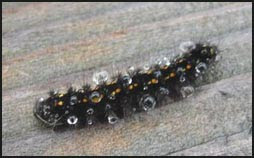
this short night -
drops of dew
on the hairy caterpillar
trans. Gabi Greve
. Yosa Buson and his haiku about the "short night" .
:::::::::::::::::::::::::::::::::::::::::::::::::::::::::::::::::::::::::::::::::::::::::::::::::::::
永き日も 囀たらぬ ひばり哉
長き日を囀たらぬ雲雀哉
nagaki hi mo saezuri taranu hibari kana
all day long
singing and not enough yet -
this lark
(tr. Gabi Greve)
Written in 貞亨4年, Basho age 44
. Matsuo Basho 松尾芭蕉 - Archives of the WKD .
:::::::::::::::::::::::::::::::::::::::::::::::::::::::::::::::::::::::::::::::::::::::::::::::::::::
nagaki hi ya yô o tsukutte kanshu yobu
A long day—
I make up an errand and
call the guard.
Itaru Ina
:::::::::::::::::::::::::::::::::::::::::::::::::::::::::::::::::::::::::::::::::::::::::::::::::::::
mijikayo ya mihatenu yume no goju-nen
Night grows short:
a dream of fifty years
breaks off before it ends.
Death Poem by Kafu
:::::::::::::::::::::::::::::::::::::::::::::::::::::::::::::::::::::::::::::::::::::::::::::::::::::
kane no ne no wa o nashite kuru yonaga kana
sounds of a temple bell
reverberate in a circle
a long night
. . . Masaoka Shiki 正岡子規
and another one by Shiki
船と岸と話してゐる日永かな
fune to kishi to hanashite iru hinaga kana
a boat and the shore
are talking together . . .
days getting longer
Tr. Gabi Greve
a boat and the shore ... Japanese language haiku-shorthand for
(a person on) the boat and (a person on) the shore.
This is not a personification
of the boat and shore doing the talking.
The scene could well be in the evening, when it is still light. Husband on board and the wife on the shore, discussing his homecoming. A lot of fishing is done from a small boat close to the shore to get seewead out of the water, for example, or uni (sea urchin) or abalones. Sometimes the men are out fishing and the whole family is on the shore to process the sea urchins for shipping (they get bad easily). They are well withing talking distance, this is a family scene, talking back and forth, once a year enjoyed by small fishing communities in Japan.
. WKD : Anthropomorphism (personification, gijinka 擬人化) .
fune to kishi to hanashi shite iru hinaga kana
the boat and the shore
conversing all day long in
terms of the water
version by Cid Corman
THF : Discussion of the Corman version
:::::::::::::::::::::::::::::::::::::::::::::::::::::::::::::::::::::::::::::::::::::::::::::::::::::
Five haiku by Masaoka Shiki about mijika yo
短夜の短さ知るや油さし
短夜の祈り験なく明けにけり
短夜の明けて論語を読む子かな
短夜を燈明料のかすりかな
短夜や蓬が宿の恋車
source : www.webmtabi.jp
餘命いくばくかある夜短し
yomei ikubaku ka aru yo mijikashi
my remaining days,
how many are there still ?
this night is short
written in Meiji 30 (1897)
how much longer
is my life?
a brief night
tr. anonymous
. - Masaoka Shiki 正岡子規 - .
:::::::::::::::::::::::::::::::::::::::::::::::::::::::::::::::::::::::::::::::::::::::::::::::::::::
the short day
letting the cat out
letting the cat in
marlene mountain
xxxxxxxxxxxxxxxxxxxxxxxxxxxxx
日短くつくづくいやなふかなさけ
hi mijikaku tsukuzu iya na fuka nasake
days getting shorter -
I grow more and more impatient
with gentle people
(English Version : Gabi Greve)
Iida Dakkotsu 飯田 蛇笏
:::::::::::::::::::::::::::::::::::::::::::::::::::::::::::::::::::::::::::::::::::::::::::::::::::::
dawn comes early -
a cool breeze
on my cheeks
Gabi Greve : akeyasushi 明易し
July 2008
:::::::::::::::::::::::::::::::::::::::::::::::::::::::::::::::::::::::::::::::::::::::::::::::::::::
short night...
dog barks speaking
to dog barks
- Shared by Louis Osofsky -
Joys of Japan, 2012
*****************************
Related words
***** Twilight, dusk (kure) a KIGO LIST !
. One day - from morning to night .
and related kigo
[ . BACK to DARUMA MUSEUM TOP . ]
[ . BACK to WORLDKIGO . TOP . ]
:::::::::::::::::::::::::::::::::::::::::::::::::::::::::::::::::::::::::::::::::::::::::::::::::::::




 Posts
Posts


12 comments:
.
Short Night (mijika yo) :
More haiku and translations are here.
::::::::::::::::::::::::::::::::::::::::::::::::::::::::::::::::::::::
a mountain hot bath
slish-slosh...
a long day
yama no yu ya daburi-daburi to hi no nagaki
.山の湯やだぶりだぶりと日の長き
by Issa, 1819
Daburi-daburi ("slish-slosh") seems to be a variant of tabu-tabu/taburi to: the movement of water or liquid that is filled to the brim; see Kogo dai jiten (Shogakukan 1983) 1020.
In this haiku the length of the day doesn't seem a negative thing.
Tr. David Lanoue
http://cat.xula.edu/issa/
"It's a foolishly long
night!" I say
in the long night
baka nagaki yo to mooshitaru yonaga kana
ばか長き夜と申したる夜永哉
by Issa, 1803
Tr. David Lanoue
http://cat.xula.edu/issa/
.
a long day--
even getting in the bath
is a chore
nagaki hi wa tada yu ni iru ga shigoto kana
.永き日は只湯に入が仕事哉
by Issa, 1821
Tr. David Lanoue
http://cat.xula.edu/issa/
long day
two blackbirds in the shade
of our grapevines
Our weather hasn't been consistently good; sunny days interspersed with moments of thick cloud and even thunderstorms.
The trick is to take one whole bunch one grape at a time.
:>) Ella
闇がりの牛を引出す日永哉
kuragari no ushi o hikidasu hinaga kana
leading the cow
out of the dark barn -
days getting longer
Kobayashi Issa
.
fune to kishi / to hanashi shite iru / hinaga kana?”
Conventionally “fune to kishi to” — “boat and shore” — is understood as a syntactical whole and constitutes the first of the three theoretical “parts,” though of course really there is only a shorter part and a longer part:
fune to kishi to hanashi shite iru (long)
hinaga kana (short)
The verse in Japanese would be printed in a single line, so matters of lineation apply for the most part only to English versions.
Mark noted:
“Also, about the translation you posted, I notice that you moved the shore to L2 though Shiki’s “line” ends after kishi.”
Actually, as above, the first “part” is “fune to kishi to,” but as already mentioned, lineation applies only to English, given that we tend to write hokku (and the later haiku) in three lines, while in Japanese they are conventionally a single line. My translation was just intended as an expression of the literal meaning of the Japanese, and does not convey Japanese syntax via lineation.
Mark added:
“I would offer that ‘fune to kishi’ could be adequately translated as ’ship to shore’ in English, especially given Shiki’s life story. Perhaps something along the lines of
ship to shore | communications continue . . . | the long day
and all that personification falls right away. Probably a good portion of the ‘poetry’ too.”
“Ship to shore” as conventionally used in English does not convey the meaning of the verse, and adding the word “communication” makes one think of a large ship in radio contact with a shore base.
Shiki’s verse, however, just refers to a fellow on a (rather small) boat talking audibly with another fellow on the shore or bank. The writer hears the slow back-and-forth conversation, and feels it in harmony with the length of the day. “Fune” in Japanese can mean a large vessel, but one can tell from the context that is not the meaning here.
It is a big mistake to apply Western poetic terms to Japanese verse. I have mentioned elsewhere how disastrously Reichhold misunderstands certain old hokku as metaphorical (not knowing the principle of “reflection” in hokku) and similarly there is no personification (as conventionally understood in the West) in this verse of Shiki. If one must have a Western approximation, it would be synecdoche, which takes the part for the whole or, as here, the whole for the part. The ship (the man on it) is talking to the (man on the) shore.
We often find this in some form in old hokku, in which “umbrellas” talk and “staves” pass through fields, which of course just means that a person with an umbrella talks to another person with an umbrella, and travelers with staves pass through fields.
I cannot emphasize strongly enough how in reading hokku one must abandon the conventional notions and expectations of Western poetry. That is something many in modern haiku (including would-be translators) often fail to do because they have never learned or understood the aesthetics of the hokku, and so the inherent poetry of hokku (and of the earliest haiku, which was generally virtually hokku in all but name and potentiality) is overlooked or overpainted with elaboration when brought into a Western context. The reason for this is that Western ideas of poetry and the poetry of hokku are for the most part two very different things.
Modern haiku in English is a hybrid form that generally has little or nothing to do with either the hokku or the later conservative haiku of Shiki. Whether one understands that as good or bad or indifferent depends on personal taste.
David Coomler
THF
http://www.thehaikufoundation.org/2010/04/13/periplum-9/comment-page-4/#comments
短夜を公家で埋たる御山哉
mijika yo o kuge de umetaru o-yama kana
the night's short
but filled with courtiers --
a high-class mountain
Kobayashi Issa 小林一茶
Comment by Chris Drake :
http://darumapilgrim.blogspot.jp/2012/11/kuge-aristocrats.html
.
明やすき夜をかくしてや東山
akeyasuki yoo kakushite ya higashiyama
Will it keep the night
So quick to end?
East Mountain.
Tr. Nelson/Saito
Yosa Buson 与謝蕪村 in Edo
Matsuo Basho at Akashi
足洗うてつひ明けやすき丸寝かな
ashi aroote tsui akeyasuki marune kana
I washed my feet
and already the night is over
after a good sleep . . .
.
永き日や何も置かれぬ違ひ棚
nagaki hi ya nani mo okarenu chigaidana
days getting longer -
nothing is placed
on the staggered shelves
Igarashi Bansui 五十嵐播水 (1899-1920)
.
more about chigaidana
短日や八丁堀の露地の中
tanjitsu ya Hatchobori no roji no naka
days getting shorter -
in the small alleys of
Hatchobori
久保田万太郎 Kubota Mantaro
.
https://edoflourishing.blogspot.com/2018/11/hatchobori-district-chuo.html
.
Post a Comment