:::::::::::::::::::::::::::::::::::::::::::::::::::::::::::::::::::::::::::::::::::::::::::::::::::::
Hiroshima Memorial Day (Hiroshima-ki)
***** Location: Japan
***** Season: Summer, August 6
***** Category: Observance
*****************************
Explanation
On August 6, 1945, the United States used its massive, secret weapon against Hiroshima, Japan. This atomic bomb, the equivalent of 20,000 tons of TNT, flattened the city, killing tens of thousands of civilians. While Japan was still trying to comprehend this devastation three days later, the United States struck again, this time, on Nagasaki on August 9.
At 2:45 a.m. on Monday, August 6, 1945, a B-29 bomber, the Enola Gay, took off from Tinian, a North Pacific island in the Marianas, 1,500 miles south of Japan.
Text with pictures is here:
http://history1900s.about.com/library/weekly/aa072700a.htm
::::::::::::::::::::::::::::::::::::::::::::::::::
Hiroshima Day has different readings in Japanese
genbaku no hi, Hiroshima-ki, genbaku-ki
原爆の日、広島忌、原爆忌
heiwa sai 平和祭(へいわさい) peace festival
KI means Memorial Day. GENBAKU means atom bomb.
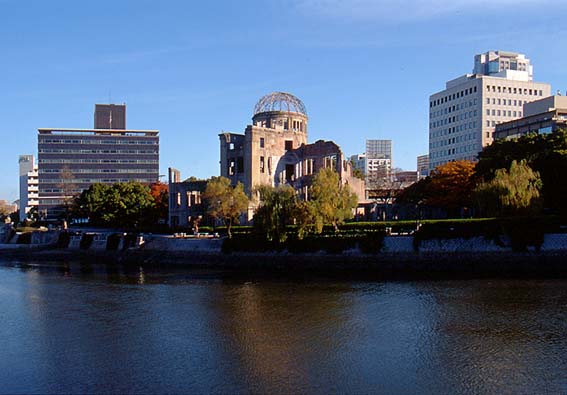
http://www.geocities.jp/yokozeki_photo/a-bomb.html
xxxxxxxxxxxxxxxxxxxxxxxxxxxxx
Yasuhiko Shigemoto
The number of survivors of the atomic bomb at Hiroshima is dwindling.
What have we all learned from this experience?
Yasuhiko Shigemoto was born in Hiroshima in 1930. He was fifteen when he suffered from A-bomb attack on the City in 1945. Having survived it, he later taught English at a senior high school in Osaka, which became his long career of forty-five years.
Meanwhile, he has been engaged in the struggle for peace both at home and abroad. His anthology, My Haiku of Hiroshima, was published in 1995. He has been giving public lectures and speeches on the theme of peace, including the speech he delivered at London University on Hiroshima Haiku also in 1995. He is one of the judges of the annual A-Bomb Memorial Day Haiku Contest* in English. The meeting of this contest is held every year at the Peace Museum of Ritsumeikan University in Kyoto.
The A-bomb at Hiroshima is not a past event for Shigemoto but very much of the present and will continue to be so unless and until all the nuclear weapons are eradicated from the face of the earth. His haiku poems are a testimony to it.
Yasuhiko Shigemoto, Osaka, Japan
http://www.worldhaikureview.org/pages/whcjapan1.shtml
xxxxxxxxxxxxxxxxxxxxxxxxxxxxx
The speech of the mayor of Hiroshima on August 6, 2004
http://groups.yahoo.com/group/happyhaiku/message/286
:::::::::::::::::::::::::::::::::::::::::::::::::::::::::::::::::::::::::::::::::::::::::::::::::::::
Horrorshima
Ground Zero 1945:
Pictures by Atomic Bomb Survivors
source : artslab13/horrorshima
*****************************
Worldwide use
*****************************
Things found on the way
*****************************
HAIKU
Hiroshima o shirazaru ko-ra yo ryuutoo-e
Children --
floating lit paper lanterns
not knowing Hiroshima
Yasuhiko Shigemoto (Japan - Hiroshima)
More Haiku on this page:
http://www.tempslibres.org/awhw/poets/ys.html
“this is our cry
this is our prayer
Peace in the world”
Sadako Sasaki, Hiroshima 1945
World Children Haiku
xxxxxxxxxxxxxxxxxxxxxxxxxxxxx
.. .. .. HIROSHIMA HAIKU
http://www.fureai-ch.ne.jp/~haiku/enhaiku.htm
1
Swallows
coming again and flying
not forgetting Hiroshima
2
Swings―
nowhere are they to be found
in the A-bomb park
3
A column of ants
reminding me of the scene
after the A-bomb dropping
4
The sunset glow―
Hiroshima
as if still burning
5
The thunderhead
looking like
an atomic cloud !
6
All alone
in silence at the dome,
Hiroshima Day
7
A-bomb blast center
no human shadows at all
the winter full moon
8
In the window
of the A-bomb Dome
full moon
9
Hiroshima Day―
I believe there must be bones
under the paved street
10
O cherry views !
never forget where you are
A-bomb blast center
xxxxxxxxxxxxxxxxxxxxxxxxxxxxx
Hiroshima Day ~
in my heart, I release
a thousand cranes
Karma Tenzing Wangchuk
Bodhisattva Institute
Tucson, Arizona USA
How to Fold an Origami Crane:
Folding a paper crane is like making peace -- some of the steps are awkward. At first it may seem impossible. There is definitely more than one route.Patience and consultation are helpful. And the result, big or small, is a thing of beauty.
Send your crane to Hiroshima !

http://www.sadako.com/howtofold.html
Gary Gach

senbazuru 千羽鶴 1000 folded cranes
in memory of the Hiroshima bomb
:::::::::::::::::::::::::::::::::::::::::::::::::::::::::::::::::::::::::::::::::::::::::::::::::::::
Hiroshima Gedenktag
Der Klang der Glocke
ueber der Stadt
Hiroshima Day -
the sound of the bell
over the town
Udo Wenzel
:::::::::::::::::::::::::::::::::::::::::::::::::::::::::::::::::::::::::::::::::::::::::::::::::::::
Hiroshima
feeding chickens
59 years later
Clifford “Kawazu”
(quoted with permission from WHCworkshop)
This Hiroshima ku is even more thought-provoking if you know that in Japan lately we get frequent warnings and threats about Chicken being raised in Thailand and other Asian countries, sold as food in Japan, but whith the strong doubt of having the bird flu to spread around with them!
Gabi Greve, 2004.
:::::::::::::::::::::::::::::::::::::::::::::::::::::::::::::::::::::::::::::::::::::::::::::::::::::

Bell of Peace at Hiroshima
Hiroshima-ki
kane ga naru wa
naru wa naru wa
Hiroshima Memorial Day -
the bell tolls and tolls
and tolls
Hiroshima Gedenktag -
die Glocke laeutet und laeutet
und laeutet
Gabi Greve, 2004
:::::::::::::::::::::::::::::::::::::::::::::::::::::::::::::::::::::::::::::::::::::::::::::::::::::
Hiroshima Fragments
mushroom clouds -
little sister tries to carry
limp young brother
river bank -
where bodies landed
eerie silence
streetcars melted -
journey back to
primal man
young students -
their skeletal remains,
final lesson
summer rain,
a stray dog searching
for his master
radiant sky,
where was the Buddha
when it happened?
over 1000 cranes
enfold the memory of
Sadako's short life*
her golden crane*
polished by children
each year
leaving Hiroshima -
Iost my way, endlessly
ask for direction
finding refuge -
lotus blossoms arising
out of mud
* Sadako Sasaki
was only two years old and lived near Misasa Bridge in Hiroshima lived near Misasa Bridge in Hiroshima when the atomic bomb was dropped. At the age of eleven she became very ill and thereafter died from radiation illness (leukemia). While in the hospital, she folded 1300 origami cranes, hoping that the gods would grant not only her wish to get well but to end all such suffering, to bring peace and healing to all victims of war. -- In 1958, a statue of Sadako holding a golden crane was unveiled in the Hiroshima Peace Memorial.
Joachim Seckel, August 2006
See also the LINK given above about Sadako.
:::::::::::::::::::::::::::::::::::::::::::::::::::::::::::::::::::::::::::::::::::::::::::::::::::::
August Six -
can we ever stop
the forces of war ?
Gabi Greve
Introducing Okamoto Taro and his "Myth of Tomorrow"
*****************************
Related words
***** Nagasaki-ki, Nagasaki no hi,
Nagasaki Memorial Day, August 9
長崎忌
Nagasaki Oshima Junior High 3rd year Students
Peace & Anti-Nuclear Haiku Poems in 1998
Destroy or dissapear
Everything, in an instant
Give me back my father and mother !
Hisako Nakagama
http://www.yoni.com/maidenf/peacehaiku.shtml
Cherry blossoms fall
Autumn breezes WHAT'S THAT LIGHT?
OH MY GOD MY *EYES* !!!!
Andrew
http://flail.com/haiku.html
The Nagasaki atom bomb 7 high war damage student mourning tombstone

There is this tombstone in the swan park which neighbors about 1.5 kilo meters of the northwest, a western city small school and a Nagasaki incarceration branch office from the atom bomb fall spot.
http://base.mng.nias.ac.jp/k18/nanakou.E.html
:::::::::::::::::::::::::::::::::::::::::::::::::::::::::::::::::::::::::::::::::::::::::::::::::::::
Contribution from Chen-ou Liu, August 2011
Disease X...
Nagasaki smoldering
here and there
Note:
"Disease X" refers to the "illness" suffered by burn victims of the atomic blast, a phrase first used by the Pulitzer Prize-winning journalist George Weller who was the first reporter to enter Nagasaki, defying a U.S. media ban in Japan.
Memorial Day --
Hiroshima mon amour
flickering
Note:
Hiroshima mon amour (English: Hiroshima, My Love) is Alain Resnais’ first feature film, unanimously viewed as the cornerstone film of the Nouvelle Vague (French New Wave). His innovative use of miniature flashbacks successfully creates a nonlinear plot line that weaves past and present, personal pain and public anguish.
tears streaking
down an American face...
Imamura’s Black Rain
Note:
Shohei Imamura’s award-winning film, Black Rain (kuroi ame 黒い雨), is adapted from the novel of the same name by Ibuse Masuji. Its narrative focus centers on the aftermath of the atomic bombing of Hiroshima, especially on the socio-psychological impact suffered by hibakusha (Japanese: the surviving victims of the atomic bombings of Hiroshima and Nagasaki), who have been in the "black rain" fallout.
:::::::::::::::::::::::::::::::::::::::::::::::::::::::::::::::::::::::::::::::::::::::::::::::::::::

. Nagasaki Bombed Maria 破壊 のマリア .
長崎への原爆投下により破壊された
浦上天主堂のマリア像 - hibaku Maria
:::::::::::::::::::::::::::::::::::::::::::::::::::::::::::::::::::::::::::::::::::::::::::::::::::::::::::::::::::::::::::
August 8, 2015 - The Japan Times
“Nagasaki had a church destroyed,” Baba said.
“The United States, the country of Christianity, destroyed a symbol of their faith with a B-29 bomber. If the gutted cathedral had been preserved the way it was, its impact would have been enormous.
It would have forever demonstrated and condemned the U.S. government’s responsibility for the atomic bombing.”

- quote -
Nagasaki’s ‘providential’ nightmare
shaped by religious, ethnic undercurrents
by Tomoko Otake
August is high season for tourism in Nagasaki. One morning last week at the Nagasaki Peace Park, the venue for an annual televised ceremony to commemorate the Aug. 9, 1945, atomic bombing of the city, throngs of tourists wearing name tags hanging from their necks were shuffling in and out of buses, snapping pictures in front of the iconic Peace Statue.
Shigeyuki Anan, a 61-year-old local historian, walked past the 10-meter bronze statue of a male deity built after World War II to wish for eternal peace. “It cost ¥40 million to build, at a time when there was no legal protection at all yet for hibakusha (atomic bombing survivors),” he said coolly.
Then he stopped at the remains of old, nondescript stone walls on the park’s edge. “This is part of the wall of a prison that used to be here,” he said, adding that 32 Chinese and Korean wartime laborers, who had been incarcerated there, perished in the bombing. “Not many people, even residents of Nagasaki, know this.”
Seventy years after a U.S. B-29 bomber dropped the plutonium bomb code-named “Fat Man,” wiping out a third of the city, killing 74,000 people and leaving hundreds of thousands more injured and suffering from lifelong effects of radiation, Nagasaki — long overshadowed by Hiroshima as the second city in the world to suffer an atomic bombing — still has many little-known stories to tell.
One longtime taboo is that the A-bomb hit the city’s underprivileged people hardest. Due to a series of mishaps and the day’s weather, the U.S. bomber changed its target at the last minute from downtown Nagasaki to an area known as Urakami, some 3 km north of the city center. Urakami — which was integrated into Nagasaki in 1920 and no longer exists as an official place name — happened to be where descendants of kakure kirishitan (Catholics who went underground in the early 17th century, when Japan closed its doors to the outside world and banned Christianity) and the burakumin social outcasts lived.
The burakumin people in Nagasaki — who made a living from leather-tanning — were relocated to Urakami in the 18th century to live closer to the underground Catholics and were forced to serve as low-level guards to keep the Christians in check.
The plutonium bomb killed 8,500 of the 12,000 Christians and 300 of the 900 burakumin in Urakami, according to the city’s records and other writings from that time.
Anan, who has viewed the atomic bombing of Nagasaki as a lens through which to look at wider issues of human rights and discrimination against religious and ethnic minorities, says some Nagasaki residents — who were faithful to the local Suwa Shrine — took the bombing of Urakami as a sign that non-Shinto believers were “punished.”
“They said the bomb fell in Urakami, not Nagasaki,” Anan said.
Such a sentiment among locals polarized Nagasaki, keeping them from uniting in an appeal for peace, experts say.
Nagasaki’s postwar peace activism has also suffered because there is no monument that can immediately call up people’s memories or spark their imagination on the magnitude of the indiscriminate killing.
Nagasaki has no structure like Hiroshima’s Atomic Bomb Dome, a building used before the blast to exhibit prefectural products, whose skeletal remains have been preserved. The structure was registered as a UNESCO World Heritage site in 1996.
In Nagasaki, less than a kilometer away from Ground Zero was Urakami Cathedral, which had provided spiritual relief to Nagasaki’s Christian community since its completion in 1925. The bombing turned the church, which was called the largest Catholic church in the East at the time, into rubble in a matter of seconds, leaving behind saint statues whose heads were blown off or whose faces were smeared with charcoal.
Despite a campaign by citizens and municipal assembly members after the war to preserve what’s left of the church as proof of the war’s ravages, then-Mayor Tsutomu Tagawa and church leaders decided to demolish the cathedral and build a new one from scratch. Only a fraction of the brick wall damaged by the bomb has been preserved. It now stands close to the Ground Zero site.
The rebuilding of the cathedral and construction of the Peace Statue mark a huge defeat for Nagasaki’s postwar peace movement, argues Shuichiro Baba, a retired journalist for the Fukuoka-based regional daily Nishinippon Shimbun who has written extensively on Nagasaki’s reaction to the A-bombing.
“Nagasaki had a church destroyed,” Baba said. “The United States, the country of Christianity, destroyed a symbol of their faith with a B-29 bomber. If the gutted cathedral had been preserved the way it was, its impact would have been enormous. It would have forever demonstrated and condemned the U.S. government’s responsibility for the atomic bombing.”
Instead, the city commissioned local sculptor Seibo Kitamura to create the Peace Statue. According to Baba, who examined interview and lecture transcripts of the artist from the 1950s, Kitamura “embodied no wish for peace.” The statue was built in the late 1950s, when hibakusha were still struggling to meet their daily needs with no medical or financial assistance from the government.
The semi-nude male deity points to the heavens with his right hand, which is meant to symbolize the horror of atomic bombs, with his left hand stretched to the side to express a wish for eternal peace.
“Kitamura said that the peace statue had to be a male deity, not a female, and that it had to be huge,” Baba said. “After the statue was completed, he laughed off a question from a reporter who asked whether peace can really be achieved in this world, saying humankind can never overcome their desires.”
Nagasaki also remains divided over another local figure: Takashi Nagai (1908-1951), a medical doctor, Catholic convert and best-selling writer, who played a significant role in shaping the postwar image of Nagasaki as “a city of prayers.”
The response to the A-bombing from survivors in Nagasaki is known to be somewhat muted compared to that of hibakusha in Hiroshima, as in the popular expression: “Ikari no Hiroshima, Inori no Nagasaki” (“Hiroshima rages, Nagasaki prays”).
A radiologist married to a woman from a longtime underground Christian family, Nagai quickly rose to fame after the war with essays based on his vivid account of caring for A-bomb victims as a physician despite suffering serious injuries, becoming ill, and losing his wife in the catastrophe.
In particular, “The Bells of Nagasaki,” published in 1949, became such a big seller it spawned a popular song under the same name and a movie based on Nagai’s life. Nagai, who suffered from leukemia, received visitors at his bedside from famous American educator Hellen Keller and even Emperor Hirohito.
Nagai’s remarks and writings, however, have been a source of fierce debate to this day. He suggested in “The Bells of Nagasaki” that the bombing of Urakami was a “providence of God,” and that Urakami was chosen to be a “sacrificial lamb” — views that some observers say were used to buttress the U.S. position that the bombing of Nagasaki helped put a swift end to the war and liberated the rest of Asia from Japan’s aggression. The observers say the comments also silenced other A-bomb victims in Nagasaki with different views on the bombing.
“It has long been extremely difficult to publicly criticize Nagai, as he was lionized by both the Occupation forces and Japan’s ruling class. And because some Nagasaki citizens viewed him as a figure that would boost the standing of hibakusha,” said Shinji Takahashi, a visiting professor of philosophy at Nagasaki University.
Takahashi is one of the first academics to criticize Nagai, writing in his 1994 book “Nagasaki ni Atte Tetsugakusuru” (“Philosophizing in Nagasaki”) that Nagai’s words “left hibakusha in Nagasaki with no choice but to keep quiet.”
“It became taboo to discuss Nagai and his views of the A-bomb, and deprived Nagasaki victims of the option to rage, pursue accountability and seek compensation,” Takahashi wrote.
Anan, before wrapping up a daylong tour of A-bomb-related sites in Urakami, stopped at Nyokodo, a two-tatami-mat wooden studio from where the bedridden Nagai penned his books in his last years. Next to the studio is a monument that says the property in Urakami used to be the house of a chokata — referring to one kakure kirishitan family in each community that was assigned the duty of orally passing on the Christian teachings and ceremonies.
Nagasaki was once home to 50,000 underground Christians, who organized a secret network of believers and passed on their faith over many generations until they were finally liberated in the Meiji Era (1868-1912), when Japan ended 250 years of seclusion and opened itself to Western powers.
Anan said he’s neutral on Nagai, noting that his “God’s providence” comments were meant to encourage Christian followers in Urakami, who, after being devastated by the A-bombing, faced further discrimination.
And while the debate over Nagai is far from over, 70 years on, it’s probably better that way so the war will stay in people’s minds, he said.
“The debate isn’t over, of course,” Anan said. “Sure, he was probably used by the Occupation. But we need to look at his words in the context of Christian persecution in Japan. I think that, through the controversy, we can keep reflecting on what the atomic bombing has meant.”
- source : Japan Times 2015 - (fb) -
:::::::::::::::::::::::::::::::::::::::::::::::::::::::::::::::::::::::::::::::::::::::::::::::::::::::::::::::::::::::::::
***** Peace and War as Haiku Topics
.................................................................................
No flash, no sound
how can we know it?
these days of peace
Fusayo Kawano
(Fukuoka Prefecture)
Radiation, War and Peace 2012
source : www.asahi.com - August 2012
:::::::::::::::::::::::::::::::::::::::::::::::::::::::::::::::::::::::::::::::::::::::::::::::::::::
notes that today, Aug. 6, is the Feast of the transfiguration of Our Lord.
"As they looked on, a change came over Him:
His face became as bright as the sun,
and His clothes as white as light."
(Matthew 17: 2) A sign of hope.
Unfortunately for the people of Hiroshima Japan and the world at large the transfiguration undergone on this day in 1945, when the sky became as bright as the sun with the first dropping of the Atomic Bomb, was not hopeful at all.
Let it never happen again.
paper lanterns
do you know how many died
at Hiroshima
- Shared by Johnny Baranski -
Joys of Japan, August 2012
:::::::::::::::::::::::::::::::::::::::::::::::::::::::::::::::::::::::::::::::::::::::::::::::::::::
分針を無言で見つめる原爆の日
a minute hand
the whole nation watches without a word
genbaku no hi
- Shared by Chie Chilli Umebayashi -
Joys of Japan, August 2012
:::::::::::::::::::::::::::::::::::::::::::::::::::::::::::::::::::::::::::::::::::::::::::::::::::::
- - - - - - Hiroshima 2013 - - - - -
this white light . . .
more than ten thousand cranes
in its shadow
Elaine Andre
with no plans
for Hiroshima
my origami crane
and this child's shadow
are taken by the wind
Louis Osofsky
lingering heat
etched in stone
atomic shadows
Fat Man
Nagasaki
sat upon
Johnny Baranski
:::::::::::::::::::::::::::::::::::::::::::::::::::::::::::::::::::::::::::::::::::::::::::::::::::::
hibaku Jizoo 被爆地蔵 bombed Jizo statues

- quote
“Jizo” is the Japanese name of one of bodhisattva. Jizo is a beloved figure of Japanese Buddhism. Stone figures of Jizo populate cemeteries, temple grounds, and country roads. Often several Jizo stand together, dressed in bids or children’s clothes.
Photo documentary book “Silent Witness: Hiroshima’s Hibaku Jizo” is published by Hiroshima photographer Ken Shimizu in May 2013 after four years he discovered a Jizo stature which survived A-bomb in 1945 near the A-bomb epicenter.
- source : www.culturalnews.com - 2013
Silent Witnesses: Hiroshima's Hibaku Jizo - A Photo Exhibition
Jizo statues are sometimes accompanied by a little pile of stones and pebbles, put there by people in the hope that it would shorten the time children have to suffer in the underworld.
Ken Shimizu exhibits his photos of Jizo which survived the atomic bombing of Hiroshima.
- reference : Hibaku Jizo

CLICK for more images.
. Jizo Bosatsu (Kshitigarbha) 地蔵菩薩 .
Introduction
:::::::::::::::::::::::::::::::::::::::::::::::::::::::::::::::::::::::::::::::::::::::::::::::::::::
.SAIJIKI ... OBSERVANCES, FESTIVALS
Kigo for Summer
[ . BACK to DARUMA MUSEUM TOP . ]
[ . BACK to WORLDKIGO . TOP . ]
:::::::::::::::::::::::::::::::::::::::::::::::::::::::::::::::::::::::::::::::::::::::::::::::::::::::



 Posts
Posts



13 comments:
in the A-Bomb Dome
there seems to be no place
for birds to build a nest
Read about August 2005 and Hiroshima Haiku,
Quote from the Japan Times
http://groups.yahoo.com/group/happyhaiku/message/1865
Gabi Greve
......................................................................
.....................................................................
August Six -
can we ever stop the
forces of war ?
. Introducing Okamoto Taro, Myth of Tomorrow 明日の神話.
Gabi Greve, August 2006
::::::::::::::::::::::::::::::::::::::::::::::::::::::::::::::::::::::
her origami crane
damaged in transit
—hiroshima
Hiroshima ...
cratered scar on the moon
of human fallibility
Ella Wagemakers
whispering stones
wind soft in summer grasses
. Peace Declaration, Hiroshima, August 2006 .
::::::::::::::::::::::::::::::::::::::::::::::::::::::::::::::::::::::
A dire warning:
Hiroshima-Nagasaki
no further please.
Aju Mukhopadhyay, India
::::::::::::::::::::::::::::::::::::::::::::::::::::::::::::::::::::::
Look at a haiga by
Carol Raisfeld, 2001
sixty years -
a child's shadow still
on the wall
Bethel
... hard for me to play witness to a witness ... but i cannot be silent either ...
dr atomic
did you know not 1 but 2
of your bombs would drop
palms joined _/|\_
.
広島や卵食ふとき口ひらく
西東三鬼
hiroshima ya tamago kû toki kuchi hiraku
Hiroshima —
to eat an egg
I open my mouth
Sanki Saito
from “Haiku Shiki” (“Haiku Four Seasons,” a monthly haiku magazine) , July 2010 Issue, Tokyo Shiki Shuppan, Tokyo
Fay’s Note:
This haiku does not have a kigo, but it is one of 8 haiku titled ‘Famous City’ by Sanki Saito (1900-1962).
Soon after an atomic bomb was dropped in Hiroshima, Sanki visited the city.
When he started to eat a boiled egg for lunch, he noticed that was the first time he opened his mouth that day.
He had been speechless with what he saw.
Fay Aoyagi
http://fayaoyagi.wordpress.com/2011/08/07/todays-haiku-august-7-2011/
.
Johnny Baranski wrote:
hibakusha
the lingering
fallout
j'ai regardé le ciel
la pluie est tombée dans ma bouche
anniversaire de la Bombe
I looked at the sky
the rain fell in my mouth
anniversary of the Bomb
(Suzuki Shin'ichi)
Post a Comment