:::::::::::::::::::::::::::::::::::::::::::::::::::::::::::::::::::::::::::::::::::::::::::::::::::::
Gods are absent (kami no rusu)
***** Location: Japan
***** Season: Early Winter
***** Category: Season
*****************************
Explanation
The tenth lunar month (now November), after the harvest when the Japanese gods had done their duty, they left their local shrines for a bit of a vacation. They would all go for an audience and to celebrate at the great shrine of Izumo, so the rest of Japan was "without gods".

There are various kigo related to this important event.
"gods-absent month", 10th lunar month,
kannazuki, kaminazuki 神無月 かんなづき
"gods-present month", month with the gods
kamiarizuki 神有月
This kigo could only be used in IZUMO itself, where the gods were present.
the gods are absent, kami no rusu 神の留守
the gods are travelling, kami no tabi 神の旅
saying good bye to the gods, sending off the gods
..... kami okuri 神送り
welcoming the gods, greeting the gods
..... kami mukae 神迎
This kigo could only be used in IZUMO itself, where the gods were arriving.
During this month, various taboos were observed all over Japan, after all, the protective deities were all away ! And in Izumo, they would be feasting and celebrating with the boss, so to speak. Okuni-Nushi no Mikoto (ookuninushi) 大国主命 was the most important deity, revered at the grand shrine of Izumo, Izumo Taisha 出雲大社.
Okuni-Nushi is also known as the god of happiness and marriage. In this respect, he is equivalent to the Buddhist Deity of Daikoku-Sama 大黒 . 大国.
The shrine compound is most serene, settled in a forest of old pines. Close by is Hino Misaki (Hinomisaki) 日の岬, with a view to the sacred island where the god stood when he fished for the Japanese Islands in the sea, as the legend goes.
I visited the area a while ago and the strong impression of the actual presence of the deities is still with me.
Gabi Greve

kami okuri 神送り saying good bye to the gods, sending off the gods
島根県八束郡鹿島町の佐太(さだ)神社で神在祭
Sada Jinja 佐太神社
73 Kashimacho Sadamiyauchi, Matsue, Shimane
- quote
a Shinto shrine in Matsue, Shimane Prefecture, Japan. The Taisha-zukuri north, central and south halls of 1807 are Important Cultural Properties.
Sada Shin Noh, ritual purification dances performed annually on 24 and 25 September, have been designated an Important Intangible Folk Cultural Property. In 2011 Sada Shin Noh was inscribed on the UNESCO Representative List of the Intangible Cultural Heritage of Humanity.
- - - More in the WIKIPEDIA !

CLICK for more images !
kamiari matsuri 神在祭 (かみありまつり) ritual to welcome the Gods
kamiari, kami-ari 神在(かみあり "gods are here"
kami tsudoi 神集い(かみつどい) gods are meeting
o-imi matsuri 御忌祭(おいみまつり)
karasade no shinji 神等去出神事(からさでのしんじ) ritual of seeing the gods off
kami mukae 神迎え (かみむかえ) "welcoming the gods"
kami kaeri 神還り(かみかえり)gods are going home, leaving
At the end of the month-long "working-meeting" at Izumo Taisha the deities gather for a final meeting
naorai 神宴(直会) to celebrate and drink ... at the shrine
万九千神社 Mankusen Jinja
before they travel back on the 26th day 神等去出.
- Three deities in residence
Kushimikenu no Mikoto 櫛御気奴命 / 櫛御氣奴命 (くしみけぬのみこと)
- honorific name of God Susano-o-no-mikoto
Oonamuchi no Mikoto 大穴牟遅命 (Okuninushi)
Sukunahikona no mikoto 少彦名命

The head priest of this temple has to get up at night and hit the closed door of the celebrating hall with a sacred plum tree branch, to tell the god's its time to hit the road.
Finally he opens the door
and then he must make a deep bow and close the eyes so as not to see the gods taking their leave.
In the compound of the shrine is a large pillar, from where the gods take off 神等去出 (カラサデ)karasade.
The Gods have come from the Sea at Izumo AMA 海(あま)から迎え山―天(あま)から送る and are then sent to heaven again - AMA 天.
kamitachi 神立 -- からさで祭 Karasade matsuri
ritual of the "Gods leaving"
at Sada Jinja on the 25th, at Izumo Taisha on the 27th.

万九千神社 Mankusen Jinja
Hikawa-cho, Aikawa, Shimane / 島根県簸川郡斐川町併川258
next to Tachimushi Jinja 立虫神社

:::::::::::::::::::::::::::::::::::::::::::::::::::::::::::::::::::::::::::::::::::::::::::::::::::::::
Izumo Kaido, The Old Road of Izumo 出雲街道
Gabi Greve
The Asian Lunar Calendar. Reference
:::::::::::::::::::::::::::::::::::::::::::::::::::::::::::::::::::::::::::::::::::::::::::::::::::::::
To celebrate sunrise, 日が昇る, prayers are sent to
. Ise Jingu 伊勢神宮 Ise Grand Shrine .
Amaterasu Omikami is a deity in charge of all things that humans can see.
To celebrate sunset, 日が沈む, prayers are sent to
. Izumo taisha 出雲大社 Grand Shrine at Izumo .
and Hinomisaki Shrine 日御碕神社 close by at the beach.
Okuninushi (Daikoku) is a deity in charge of all things that humans can not see, especially relationships and feelings.
目に見えない世界 - 神事(かくれたること)
The great shrine at Izumo, where the Gods are celebrating
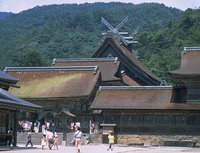
Click on the PHOTO to look at more !
External LINKs
Shimane and its Important Shrines
Great Shrine at Izumo, Izumo Oyashiro
Japanese Homepage 日本語
:::::::::::::::::::::::::::::::::::::::::::::::::::::::::::::::::::::::::::::::::::::::::::::::::::::::::::::::::::::::::::
- quote
Izumo Shinkō
is the faith centered around the shrine Izumo Taisha in Taishamachi, Shimane Prefecture. The "enshrined kami" (saijin) Ōkuninushi has many variant names or titles modifying those names, and from these we know that he was worshipped as, among other things, an earth kami, as the king or possessor of the land of Japan, and as a kami of land reclamation and agriculture. From the distribution of legends concerning the kami associated with Ōkuninushi in the Izumo no kuni fudoki (733) we can see that the cult of Izumo encompassed the entire Izumo region.
Until the Bakumatsu Period, Izumo Taisha was generally referred to as Kidzuki Taisha, and the shrine's foundation legend (which describes Ōkuninushi's "relinquishing the land" (kuniyuzuri), accompanied with the construction of a tremendous shrine) seems to reflect the historical unification of the Japanese nation. There are, however, many theories concerning the era of the shrine's founding, and no definitive interpretation has been settled upon. The officiant of Izumo Taisha, the "governor of Izumo" (Izumo kokusō – also read as kuni no miyatsuko), worshipped both his traditional "clan kami" (ujigami) at Kumano Jinja (the present-day Kumano Taisha) and also at Izumo. From the Nara Period into the first half of the Heian Period, every time a new kokusō took office, he would travel to the capital and recite the norito "Izumo no kuni no miyatsuko no kanyogoto."
At first the central government regarded Kumano more highly than Izumo, but from the second half of the Heian Period, Izumo Taisha became an ichinomiya, and its land holdings were increased, numbering twelve towns and seven seaside villages in the Kamakura Period. At the end of the medieval period, the amount of rice garnered from these holdings amounted to about 5,400 koku, but in 1591 the shrine was stripped of all but five towns and two seaside villages, in order to fund Mōri Terumoto's dispatching of troops to the Korean Peninsula. Except for an increase of "fields that provide rice offerings" (saiden) and of lands to provide for shrine repairs, Izumo didn't recover the lost tribute land until the Bakumatsu Period.
Activities of oshi (shrine priests who guided and hosted pilgrims) related to Izumo Taisha date back to approximately 1532 - 1555 but it is thought that the economic problems cited above explain the sudden increase in their activity. In many regions there is a legend that the kami gather at Izumo during the tenth month of the lunar calendar. At Izumo this month is referred to as kamiaritsuki (the month when the kami are present). In accordance with this legend, the tenth month was referred to as kannadsuki (the month when the kami are absent) throughout the rest of Japan.
An early example of this term can be found in the Ōgishō, written in the first half of the twelfth century, and the term kamiaritsuki appears in the Kagakushū, written in the Muromachi Period (1444). These terms spread widely in the first half of the sixteenth century due to such texts as the yōkyoku (Noh script) Ōyashiro. These legends probably derive from local customs of greeting and seeing off the "kami of the rice paddy" (ta no kami) and from igomori festivals (abstinence and confinement to purify the self before religious events). Rites for the gathering of kami are also conducted at the shrines Sada Jinja and Kamosu Jinja in the Matsue area, but Izumo Taisha's Kamiari Festival became particularly famous. The cult of enmusubi (connecting romantic couples or enabling marriage) through the kami of Izumo seems to be an early modern development created by the activities of oshi.
Somewhat older, however, is a cult relating to the "deities of prosperity" (fukutokujin) which held that Ōkuninushi was the deity Daikokuten. In Indian religion, Daikokuten was the deity of battle, Mahākālā; in T'ang Dynasty China he was adopted as a Buddhist deity of food; and in Japan he became a guardian deity of Buddhist temple kitchens. The conflation with Ōkuninushi derives from the homophonous characters "大黒" (read "daikoku") and "大国" (read "daikoku" or "ōkuni"), and from the similarity of the two deities' characters as guardian kamis of food. Evidence of the conflation of these deities was recorded in the Chiribukuro written in the mid Kamakura period. In Japan's Shikoku and Chūgoku regions, there are many "Izumo yashiki" buildings. These structures have been purified with small amounts of sand taken from below the floor of the Soga no Yashiro, which stands behind the "main shrine" (honden) of Izumo Taisha. People thereby make a spiritual offering of their land or homes to the ruler of the land, Ōkuninushi, in order to receive his protection.
At the beginning of the Meiji Period, Izumo Taisha emphasized the legend of "relinquishing the land" (kuni yuzuri) – namely, a peaceful transfer of land. The shrine also actively incorporated the notion that Ōkuninushi was a kami who ruled the other world (originally posited by Hirata Atsutane), in order to preach about a peaceful afterlife and to appeal for the introduction of Shinto-style funerals (shinsōsai). At this time, two religious groups were established, based around associations for worshipping the kami ("keishinkōsha") and on places of assembly. The two religious groups are the Izumo Ōyashirokyō, connected with the Senge clan of governors (kokusō), and the Izumokyō, connected with the Kitajima clan of kokusō. The combined number of believers in these groups is claimed (by the sects themselves) to exceed 1,500,000. See also Izumo Taisha, Izumo Taishakyō, and Izumokyō.
- source : Hirai Naofusa - Kokugakuin 2006
*****************************
Worldwide use
*****************************
Things found on the way
. The regional 六所神社 Rokusho Jinja Shrines .
They are resting places for the deities on their journey to Izumo.
Koya San in Wakayama 高野山 和歌山県
By Gabi Greve
See the Haiku below.
:::::::::::::::::::::::::::::::::::::::::::::::::::::::::::::::::::::::::::::::::::::::::::::::::::::
Grand Shrine at Izumo
"Since ancient times, there have been records of Izumo Taisha once having been housed in a 45-meter-high building, but those records couldn't be substantiated," commented the information guide at the hall. "But then in 2000, enormous pillars were discovered that could have supported a structure of that height.
That would have made it taller even than Todaiji, the temple housing the giant Buddha in Nara."
Read an interesting article:
Izumo : Here be the land of the gods
By CHRIS BAMFORTH
*****************************
HAIKU
風寒し破れ障子の神無月
kaze samushi yabure-shooji no kannazuki
cold wind
through our torn paper doors
in the month without gods
. Yamazaki Sokan 山崎宗鑑 Yamazaki Sookan .
1465 - 1553
:::::::::::::::::::::::::::::::::::::::::::::::::::::::::::::::::::::::::::::::::::::::::::::::::::::
さをしかや 神の留守事 寝て遊ぶ
saoshika ya kami no rusu koto nete asobu
young buck--
while the gods are away
sleeping and carousing
Tr. David Lanoue
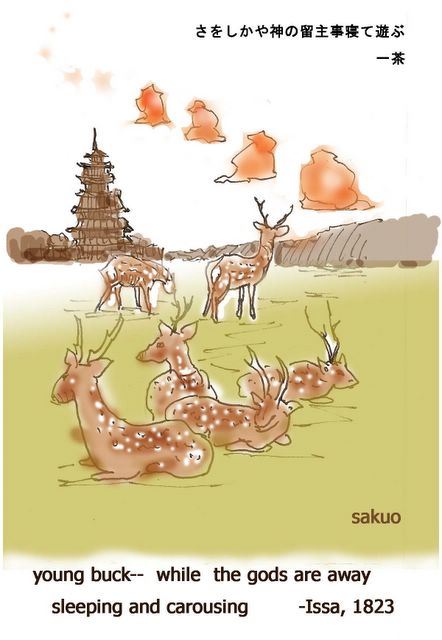
Haiga by Nakamura Sakuo
けふからは薬利くべし神迎
kyoo kara wa kusuri kiku beshi kami mukae
from today on
may my medicine work!
welcoming the gods
Tr. David Lanoue
. Kobayashi Issa 小林一茶 Issa in Edo .
:::::::::::::::::::::::::::::::::::::::::::::::::::::::::::::::::::::::::::::::::::::::::::::::::::::
ranto no torii ya ge ni mo kannazuki
passing the torii gate
made of grave stones
Month without Gods
Kikaku
Another Haiku stone I found on Mt Koya.
This one is difficult to explain. The general meaning is: although there are torii gates (a symbol of Shinto shrines) in front of the graves, they have been built of grave stones, and on top of that, Mt Koya is the territory of the Buddha, there are no Japanese native deities here. And that beautifully fits the fact that the author, Kikaku, makes his visit to the mountain in October, the month which was called Kannazuki, or the Month without Gods. In short, this haiku is a crafty play on words.
From a great BLOG about Haiku Stones:
Copyright Ad G. Blankestijn, 2006. All rights reserved
:::::::::::::::::::::::::::::::::::::::::::::::::::::::::::::::::::::::::::::::::::::::::::::::::::::

month without gods
only this brilliant moon
and I
kawazu - Cliff T. Roberts
Fort Worth, Texas. USA, November 2011
*****************************
Related words
I left the capital
and shared many nights on the road
with the gods
Matsuo Basho at Shrine Numazu Hie Jinja
***** . Sannoo matsuri 山王祭 (さんのうまつり) Sanno Festival .
Hiyoshi matsuri 日吉祭(ひよしまつり) Hiyoshi shrine festival
sarumatsuri 申祭(さるまつり)monkey festival
with the haiku by Matsuo Basho
:::::::::::::::::::::::::::::::::::::::::::::::::::::::::::::::::::::::::::::::::::::::::::::::::::::::::::::::::::::::::::
[ . BACK to DARUMA MUSEUM TOP . ]
[ . BACK to WORLDKIGO . TOP . ]
:::::::::::::::::::::::::::::::::::::::::::::::::::::::::::::::::::::::::::::::::::::::::::::::::::::::::::::::::::::::::::



 Posts
Posts


21 comments:
How timely, Gabi san!
I was reading earlier this evening, a tanka written by Monk Noin (988 - 1050), that refers to Izumo:
kannazuki/nezame ni kikeba/ yamazato no/ arashi no koe wa/ ko no ha narikeri
In the Godless Month
I wake at night and listen
to what gives voice
to a storm on this hillside . . .
the sound of falling leaves
translated by Steven D. Carter
Says Dr. Carter:
"The Godless Month is an "ancient name for the tenth month of the lunar calendar; derived from an ancient belief that the gods left their normal shrines during that period to gather at Izumo, site of an ancient shrine dedicated to the diety, Okuninushi."
Thanks as always for your sharing of Japanese culture.
robert wilson
http://groups.yahoo.com/group/cherrypoetryclub/message/29232
Thank you, Gabi san
for the pictures and sharing the spirit of the place.
Michele
http://groups.yahoo.com/group/cherrypoetryclub/message/29234
Gabi,
Thanks for this information, it is facinating. Imagine a form of worship where the gods get the month off to vacation!
S. from America !
kami-gami no rusu sentaku ya kyoomo ame
trying to do my laundry
while the gods are away...
another day of rain
Issa, tr. David G. Lanoue
A note says:
Shinji Ogawa notes that Issa is playing with the idiomatic
expression, oni no inain ma no sentaku ("laundering while the devil's away" => "when the cat's away, the mice will play"). Issa
substitutes "the gods" for "the devil."
..................................
rusu no ma ni aretaru kami no ochiba kana
the gods gone
everything desolate among
the dead leaves
Basho (Tr. David Barnhill)
Barnhill says of this haiku:
"This hokku has been read symbolically to reflect Basho's long absence from Edo and his disciples there."
...................................
Zendera ni matsuno ochiba ya kannazuki
In the Zen temple,
Pine needles are falling;
The god-less month.
Bonchoo, tr. Blyth
...................................
entei no ikari ni waga no kami midare
in the fire god's
anger my hair gets
all tangled up
Yasushi Ueno, tr. Higginson, from "Haiku World" under "Summer--the Season"
Compiled by Larry Bole
::::::::::::::::::::::::::::::::::::::::::::::::::::::::::::::::::::::
black kites reeling
reeling in the sky...
the gods depart
tobi hyoro-hyooro kami no o-tachigena
.鳶ひょろひひょろ神の御立げな
by Issa, 1815
According to Shinto belief, in Tenth Month all of Japan's gods vacate their shrines to congregate at the Izumo-Taisha Shrine. The "black kite" in the scene (tobi) is a bird, not the paper kind. R. H. Blyth believes that the phrase, hyoro-hyooro ("staggeringly," "reelingly"), is an onomatopoeic representation of the birds' cry, which resembles the "piercing, melancholy sound" of ceremonial flutes; A History of Haiku (Tokyo: Hokuseido, 1964) 1.382. For this reason, he doesn't translate it (1.381).
The ending gena is the equivalent of rashii or yooda in modern Japanese; it denotes a presumption or estimation. See Kogo dai jiten (Shogakukan 1983) 567. Therefore, a more literal but wordy translation of the final phrase would be: "the gods are departing, it seems."
Tr. David Lanoue
http://cat.xula.edu/issa/
The verse above is the hokku of a famous renku composed by Issa and Ippyō (Ippyō was the priest of Hongyōji, a temple located near Nippori in Edo.
From Scot Hislop's commentary to the han-kasen:
鳶(とび)ひよろひひよろ神も御立(おたち)げな
the kite p-peeps, p-p-peeps
the gods too,
seem to be getting ready to depart
Tobi, or kite, is raptor that lives in cities and by the sea and feeds mostly on small dead animals. It was also slang for those without steady jobs and for dilettantes and gamblers. Perhaps Issa is referring to himself.
The kigo (seasonal word) is kami no tabidachi which refers to the 10th month when the gods travel to Izumo. This hokku does not have a formal kireji (cutting word) in it but there is a natural pause after “ひよろひひよろ” which has been “translated” as a line-break here.
Maruyama (in Maruyama Kazuhiko, Issa to sono shūhen, Tokyo: Kashinsha, 2000) writes that the kites can be seen as providing the music for the gods who are getting ready to travel and that the “nursery tale style of expression and the colloquial style of the last phrase are interesting.”
Norman Darlington
http://groups.yahoo.com/group/translatinghaiku/message/1837
stormclouds ...
a curtain of rain
hides the gods
thunder ...
yet I do not hear
the gods
in the sky
nameless gods
but then
the strong earth
the straight tree
小猿ども神の御留主を狂ふ哉
ko-zaru domo kami no o-rusu o kuruu kana
these little monkeys -
while the gods are absent
they run around like crazy
Kobayashi Issa
Monkeys - WKD
. Masaoka Shiki 正岡子規 visiting shrines and temples
さそひあふ末社の神や旅でたち
sasoi-au massha no kami ya tabi detachi
the gods of the subordinate shrines
are inviting each other -
time for travelling
.
Matsuo Basho and
- rusu 留守 nobody at home -
神棚も仏壇もなく神の留守
kamidana mo butsudan mo naku kami no rusu
no altar for the gods
and no Buddhist family altar -
the gods are absent
Yamauchi Yuushi 山内遊糸 (born 1925)
MORE
about kamidana
November 05
enmusubi no hi 縁結びの日 day day of making good connections
(finding a husband or some other kind of good "en" in life)
goroawase. i i go en 「いい(11)ご(5)えん」
.
Calendar Days in November
Tottori 鳥取県
If you have to take a pee while standing in the 10th lunar month, you have to call out
「オタチ、オタチ」"I am standing here to pee!" twice.
In this month, the Japanese deities assemble in Izumo and need to be informed of the act, so they can evade being hit.
.
http://wkdhaikutopics.blogspot.jp/2007/12/pissing-shooben.html
神の留守狐の飛脚戻りけり<B>
kami no rusu kitsune no hikyaku modorikeri
the gods are absent
and the fox messenger
comes back . . .
. Ochi Etsujin 越智越人 (1655 - 1739) .
more about
Hikyakugitsune 飛脚狐 伝説 legends about fast fox messengers
.
http://heianperiodjapan.blogspot.jp/2016/03/hikyaku-fox-legends.html
田の神 山の神 kigo for haiku related to seasonal events
.
https://japanshrinestemples.blogspot.jp/2017/08/ta-no-kami-festivals-matsuri.html
.
. kami no rusu 神の留守 "the Kami are absent" .
kami no tabi 神の旅 the gods are travelling,
After the harvest, Tanokami takes a break to meet all the other Kami at Izumo.
ta no kami matsuri 田の神祭り Tanokami festivals and rituals
for the God of the Rice Fields and for 山の神祭り Yamanokami
.
https://japanshrinestemples.blogspot.jp/2017/08/ta-no-kami-festivals-matsuri.html
.
Ta no Kami, Tanokami 田の神 God of the Rice Fields
and inoko 亥の子 / イノコ / 亥子 the "young wild boar" legends
Niigata 新潟県 .....
南魚沼郡 Minami-Uonuma district 六日町 Muika machi
留守居の神 rusui no kami,恵比寿様 Ebisu sama,便所の神 benjo no kami
On the day of Inoko people prepare Inoko dango 亥の子ダンゴ round rice dumplings.
.
When most of the Kami left for Izumo, only Ebisu and the Benjo no Kami of the Toilet stayed back in the homes. They were the rusui no kami, Gods keeping back home. For them, the round rice dumplings were an offering. Also called
inokori dango 居残りダンゴ round rice dumplings for those left behind.
.
https://japanshrinestemples.blogspot.jp/2017/10/tanokami-inoko-legends.html
.
Legend from Fukui
.......................................................................
大飯郡 Oi district 高浜町 Takahama
On the 28th day of the 9th lunar month, the Deities are seen off (to the great meeting in Izumo 出雲). They come back on the 28th day of the 10th lunar month.
But Yamanokami is seen of on the 8th day of the 10th lunar month and comes back on the 8th day of the 11th lunar month.
The tenth lunar month (now November), after the harvest when the Japanese gods had done their duty, they left their local shrines for a bit of a vacation. They would all go for an audience and to celebrate at the great shrine of Izumo, so the rest of Japan was "without gods".
.
https://japanshrinestemples.blogspot.jp/2017/08/yama-no-kami-07-regional.html
.
Legend from Fukushima
いわき市 Iwaki town
On the first day of the 10th lunar month, all the Kami take off to 出雲 Izumo to have a rest and celebrate. This is called
kantachibi カンタチビ in the local dialect.
In the Iwaki region however, Kamadogami 竈神 the Kami of the kitchen hearth and Ebisu 恵比寿神 stay back where they always are.
.
https://japanshrinestemples.blogspot.jp/2017/08/yama-no-kami-08-regional.html
,
Legend from Hyogo 兵庫県
出石郡 Izushi district 高橋村 Takahashi village
At the Shrine for 牛頭天王 Gozu Tenno there was roosugi 老杉 an old cedar tree.
From the 10th lunar month until winter people could hear the sound of drums near the tree. Sometimes there was the sound of the tree falling down.
On the night of the third day of the 11th lunar month at the time of ushimitsu 丑満ツ / 丑三つ there comes a storm an the trees are groaning.
This is when the gods come home from their yearly trip to 出雲 Izumo.
. ushi mitsu 丑満ツ / 丑三つ the double-hour of the ox .
A time when the spirits of the dead and the gods are alive too.
.
https://japanshrinestemples.blogspot.com/2020/03/gozu-tenno-legends.html
.
Legend from Kochi
幡多郡 Hata district 西土佐村 Nishi-Tosa village // 石神さん
.
. kannazuki 神無月 month where the Kami are absent .
kami no rusu 神の留守 the gods are absent
This is the 10th lunar month, when the Kami father at 出雲 Izumo.
During that time Izumo no matsu 出雲の松 the pine of Izumo begins to bend.
Konpira san 金毘羅さん and 石神さん Ishigami san do not go.
.
https://japanshrinestemples.blogspot.com/2020/03/ishigami-stone-deity-2.html
.
Post a Comment