:::::::::::::::::::::::::::::::::::::::::::::::::::::::::::::::::::::::::::::::::::::::::::::::::::::
Blackthorn flower
***** Location: Europe
***** Season: Mid- Spring
***** Category: Plant
*****************************
Explanation
There are many types of fruit trees in the
Soure Plum SUMOMO group.
Here we are concerned with
Prunus spinosa, Spinosa sumomo スピノサスモモ
This is one of the parent trees of the plum, the European Sumomo(ヨーロッパスモモ、セイヨウスモモ).

http://www.ne.jp/asahi/plant/stamps/stamps/rosaceae.htm
xxxxxxxxxxxxxxxxxxxxxxxxxxxxx
Blackthorn is apparently the parent species of all the blossoming plums of Eurasia. Like most wild, uncultivated varieties, it is a bit smaller and more showy than its cultivated offspring, and perhaps less commonly seen by city folks, but country folks in the British Isles know it well.
It blooms with some variation, from March into April, and is thus appropriate for mid spring.
As the plant apparently originated in central Europe, and has spread pretty much throughout the wilds of temperate Eurasia, it seems well known to many.
Some names for it in other languages
German, "der Swartzdorn" or "der Schlehdorn";
French, "Epine noire" [f] or "prunellier" [m] .
It is so striking when the flowers emerge from the otherwise deeply black and lifeless stems and branches, like the earliest cherries, but even more striking is their black-and-pale-pinkish-white contrast. "Petals on a wet, black bough" indeed!
William J. Higginson
:::::::::::::::::::::::::::::::::::::::::::::::::::::::::::::::::::::::::::::::::::::::::::::::::::::
.. .. .. Some Links:
GAELIC NAMES : DRAIGHEAN, DRAIGHEÁN.
USES :
A tea made from blackthorn leaves is a mild purgative, it also helps bladder problems, catarrh and bronchial problems. Juice of fresh berries helps inflammations of the throat, although is very astringent/drying. A jam made from the fruit makes a palatable laxative. A decoction of the roots is said to cure fever.
Read more here:
http://www.shee-eire.com/Herbs,Trees&Fungi/Trees/Blackthorn/Factsheet1.htm
Blackthorn blossom in a country lane near Tiptree in mid April
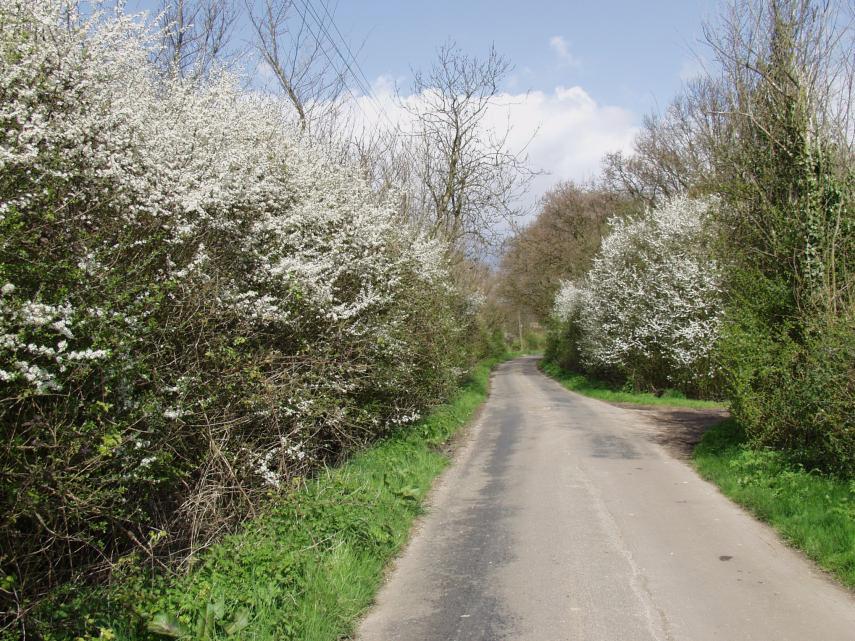
copyright © of Barry Samuels
http://www.beenthere-donethat.org.uk/blackthorn02big.html
xxxxxxxxxxxxxxxxxxxxxxxxxxxxx
Revered by the Druids, who thought it magical, the dense foliage shelters many species of wildlife, provides nest sites for birds and hibernation places for butterflies, and is the larval food plant of a number of insects vital to the overall health of the countryside.
And still we treat it as if it were some alien invader.
http://tinyurl.com/7vz5r
*****************************
Worldwide use
*****************************
Things found on the way
.. .. .. .. .. Sloe Gin
Ingredients:
1 lb. (450 g) sloes
3 cups (710 ml) gin or vodka
1 1/2 cup (350 g) sugar
Sloes are the fruit of blackthorn and are actually a wild type of plums. The flavor of the fruit is bitter, so the small plums are not suitable for eating. However, the effect of frost makes them milder. The bitter flavor is lost when making liqueurs.
Sloe gin is traditionally made in Ireland and Britain. Sloe liqueur is also made in Scandinavia, Germany, France and Spain. This delicious liqueur has a flavor similar to plum liqueur and the color is dark red. It is best served in small amounts as an after-dinner drink with or without ice.
Read the recipe here
http://www.liqueurweb.com/sloe.htm
:::::::::::::::::::::::::::::::::::::::::::::::::::::::::::::::::::::::::::::::::::::::::::::::::::::::
March snow -
blackthorn flowers wait
for the sun
- Shared by John Byrne, Ireland -
Haiku Culture Magazine, 2013
*****************************
HAIKU
.. .. .. Morning Sedoka
Blackthorn cloaked in frost,
undresses in the morning,
as the sun peeps through the trees.
Andrew Hide
http://www.thepeoplespoet.com/pages/poeticforms.htm
xxxxxxxxxxxxxxxxxxxxxxxxxxxxx
almost autumn
the blackthorn's shadow
both sides of the wall
paul conneally
http://www.charnwood-arts.org.uk/webworks/webworkshaiku.php?imageid=1489
*****************************
Related words
***** (Sour) Plum flower, Sumomo flower 李花
kigo for late spring in Japan.
sumomo no hana 李の花 (すもものはな) Sumomo blossoms
flower of the plum, rika 李花
Sumomo plum flowers falling, sumomo chiru 李散る
The origin of this tree is in China, but it was introduced to Japan around 500. In April small flowers begin to be visible.
.................................................................................

sumomo 李 (すもも) "sour plum"
..... 李子(すもも)、yonemomo 米桃(よねもも)
botankyoo 牡丹杏(ぼたんきょう)
Prunus salicina - スモモ
The fruit are ripe in June and July and are a
kigo for early summer.
reines-claude in French
Reneclaude in German
Do not mix this PLUM with the prune, which is also a kind of plum.
And to not mix it with this plum, ume, Prunus mume, of the apricot family.
Plum blossom (ume) Japan:::::::::::::::::::::::::::::::::::::::::::::::::::::::::::::::::::::::::::::::::::::::::::::::::::::
observance kigo for late summer
***** sumomo matsuri すもも祭 (すももまつり)
Sumomo plum festival
..... 李祭(すももまつり)
sumomo ichi すもも市(すももいち)Sumomo market
karasu uchiwa 烏団扇(からすうちわ)"craw fan"

July 20 at the shrine Ookunitama 大国魂神社 Okunitama Jinja
A market for sweet-smelling sour plums where Japanese "black crow" fans (known to ward off evil and bring divine happiness) are be distributed.

quote
The sumomo matsuri
is a festival held on July 20 at Ōkunitama Jinja in Fuchū City, Tokyo Prefecture, in which special offerings (shinsen) of plums and rice with chestnuts (kurimeshi) are offered to the kami. Eating the plums on the day of the festival is believed to exorcise evil spirits and prevent summer maladies.
Fans painted with drawings of crows are distributed to the worshipers with the belief that waving the fans at the fields prevents insects from attacking the crops. Before the mid-Edo period, this festival was considerably larger, eclipsing the same shrine's kurayami matsuri in size.
source : Mogi Sakae, Kokugakuin, 2006

Look at the kagura dance here
source : www.youtube.com
. OBSERVANCES – SUMMER SAIJIKI .
. Fan (oogi 扇 - uchiwa 団扇) .
. Fuchuu matsuri 府中祭 (ふちゅうまつり)
Fuchu Festival .
May 5 at the shrine Ookunitama 大国魂神社 Okunitama Jinja
[ . BACK to DARUMA MUSEUM TOP . ]
[ . BACK to WORLDKIGO . TOP . ]
:::::::::::::::::::::::::::::::::::::::::::::::::::::::::::::::::::::::::::::::::::::::::::::::::::::




 Posts
Posts


1 comment:
Kobayashi Issa
もまれてや江戸の李は赤くなる
momarete ya edo no sumomo wa akaku naru
handled and squeezed
Edo's plums
turn red
Issa implies that the plums are blushing with shame. He later revises this haiku, replacing "plums" with "mushrooms" (kinoko).
David Lanoue
.
Post a Comment