:::::::::::::::::::::::::::::::::::::::::::::::::::::::::::::::::::::::::::::::::::::::::::::::::::::
Awaodori Dance 阿波踊り
***** Location: Japan
***** Season: Early August
***** Category: Observance
*****************************
Explanation
This is a special dance that originated in Tokushima (Shikoku) more than 400 years ago.
It is performed during the days of the Bon Festival (o-bon) in many parts of Japan nowadays.

There are three different theories about the origins of the Awa Dance.
One is that it is a version of the Bon Odori, a dance performed in summer throughout Japan.
Another is that it began from a celebration of the completion of Tokushima Castle when Hachisuka Iemasa provided sake for the townspeople who got drunk and began to dance with abandon. The Awa Dance features organized teams of dancers, which is suggested to have been influenced by "Furyu"-a performing art from the Heian period that later became Noh.
The third theory relies on Miyoshi district records from the year 1663 of a Furyu dance at the Shozui Castle, considering this performance to be the origin of the Awa Dance. In the 1920s the dance festival became organized to attract tourism and was named "Awa Odori." Every August 12th to 15th the streets of Tokushima teem with high-spirited folks enjoying a festival atmosphere.

The Awa Dance is held in the city of Tokushima using the main downtown streets as a stage. It starts in the evening (6:00 p.m.) and the dancing lasts until 10:30 p.m. The main performances are held on outdoor dance stages or strips built in the downtown parks and streets. Eight are on stages, four in plazas, two along roads, and six at streetcorner spaces.
The Awa Dance is held not only in the city of Tokushima but also in Naruto, Ikeda, Kamojima, Sadamitsu, and other locales in the prefecture. All of Tokushima prefecture catches the summer fever when it comes to Awa Odori.
http://www.tokushima-kankou.or.jp/foreign/english/awaodori/
xxxxxxxxxxxxxxxxxxxxxxxxxxxxx
Other kigo with respect to the Bon dancing:
Bon dancing, bon odori 盆踊
dancing , odori 踊
..... nagashi ながし..... zomekiぞめき
..... Bon yatsushi 盆やつし
Dance for the souls, shooryoo odori 精霊踊
Memorial Dance, kuyoo odori 供養踊
Lantern Dance, tooroo odori 燈篭踊
Dance for a good year, hoonen odori 豊年踊

hat for dancing, odori-gasa 踊笠
There are regional differences in this hat.
light kimono for dancing, odori-yukata 踊浴衣
drum for the dance, odori daiko 踊大鼓
song for the dance, odori-uta 踊唄
..... ondotori 音頭取(おんどとり)
dancer, odoriko 踊子(おどりこ)
place for the dance, odoriba 踊場
dancing in a circle, odori no wa 踊の輪
kokiriko odori 小切子踊(こきりこおどり)Kokiriko dance
In Gokayama, Fukuyama prefekture and a few parts of Niigata in Kashiwazaki.
富山県五箇山

kokiriko is a special instrument made from bamboo, it is about 20 to 30 cm long. One stick is held in each hand and hit to produce a suond.
. . . CLICK here for Dance Photos !
Other souces say the kokiriko is a kind of
. sasara clapper ささら .
okesa odori おけさ踊(おけさおどり)Bon dance in Echigo
Also in Sado Island.
. . . CLICK here for Photos !
Sado Okesa 佐渡おけさ - LOOK and LISTEN:
source : www.youtube.com
Kiso odori 木曾踊(きそおどり)Bon dance in the Kiso region
長野県木曽福島
Kisa Odori - LOOK and LISTEN:
source : www.youtube.com
. sansa odori さんさ踊(さんさおどり)Bon dance in Morioka .
August 1 - 4
Sansa Odori - LOOK and LISTEN:
source : www.youtube.com
:::::::::::::::::::::::::::::::::::::::::::::::::::::::::::::::::::::::::::::::::::::::::::::::::::::
Song of the Dancers in Awa
odoru ahoo ni miru ahoo onaji ahoo nara odoranya son son
odoru aho ni miru aho onaji aho nara odoranya son son
tanzende Narren ........... dancing fools
zuschauende Narren .... watching fools
wenn schon ein Narr .... if I have to be a fool
dann lieber tanzen . ....... I'd rather dance
:::::::::::::::::::::::::::::::::::::::::::::::::::::::::::::::::::::::::::::::::::::::::::::::::::::
Read a charming article about the Shiraishi Odori, a Bon dance held in the memory of Shiraishi island ancestors.
By Amy Chavez, August 2005
http://blog.livedoor.jp/worldkigo/archives/30497631.html
xxxxxxxxxxxxxxxxxxxxxxxxxxxxx
Koenji Awa-Odori Dance Festival
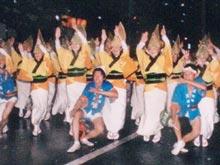
The Dancers forming dance units called "Ren", dance around the street or trough the spectators' seats. Ren, a dance unit, usually consists of a carrier of lanterns with the group's name on at the head of line, then female dances (kid dancers), male dancers and at the back a musical accompaniment called "Narimono" who play traditional instruments including shamisens, flutes, bells and drums.
The female dance features dancing on tiptoe with a wattle hat low over their eyes, waving the lithe hands above the head, and the male dance, its dynamic movements will catch your eyes. The lilt dance and music is very exhilarating to experience!
http://events.paperlantern.net/view_entry.php?id=329&date=20050826
. Kooenji 高円寺 Koen-Ji Awaodori Tokyo .
*****************************
Worldwide use
*****************************
Things found on the way
Awaodori Chicken 阿波尾鶏 from Tokushima
A special breed from 1989, with respect to the Awa Odori 阿波踊り dance of Tokushima and is known for its beautiful tail. Breeding time is only 80 days, so it is rather cheap.
ODORI here does not mean dance, but LONG TAIL !
***** WASHOKU : Awaodori 阿波尾鶏 from Tokushima
:::::::::::::::::::::::::::::::::::::::::::::::::::::::::::::::::::::::::::::::::::::::::::::::::::::
Sunday, January 22, 2012
Awa dance performed in cold river
Tens of people performed the traditional Awa dance in a cold river in Tokushima City, western Japan, on Sunday.
The summer dance was performed in the Shinmachi River running through the central part of the city.
About 30 people wearing traditional yukata and happi entered the water all at once, and moved their hands in a unique Awa dance style, while calling out "Yattosa".
An 86-year-old man received a round of applause as he wrote the character for dragon, which is this year's sign, while treading water.
The water temperature was 11 degrees Celsius as of 9 AM, and the dancers were shivering as they came out of the river. They said the cold water straightened them out and made them feel refreshed.
source : www3.nhk.or.jp
水中阿波踊り

*****************************
HAIKU
. WKD : Kobayashi Issa 小林一茶 in Edo .
踊から直に草刈さはぎ哉
odori kara sugu ni kusa karu sawagi kana
still in dancing duds
people make quite a racket
cutting wild grass
Tr. Chris Drake
This early autumn hokku was written in the 7th month (August) in 1822. It is the time when people are preparing for the big Bon (or, more honorifically, O-Bon) Festival of Returning Souls, a festival that mixes popular Buddhism with shamanic ancestor worship. The main part of the Bon Festival, one of the biggest festivals of the year, lasts for three days (7/14-16) at the time of the full moon and climaxes with a great ring dance, often with several rings of dancers, only half of whom are visible, since half of the dancers are the invisible souls of ancestors. The week before this great dance with invisible souls -- a kind of group possession -- is one of hectic preparation: houses and home altars to ancestors are thoroughly cleaned and prepared for the return of the souls of recent ancestors, while outside much high, vigorously growing wild grass has to be cut to clear the paths to graveyards and the graveyards themselves, many of which are located on hills or on the slopes of mountains, places which souls are believed to use as doors between the other world and the visible world.
Since the souls of the dead are also believed to be gods and/or Buddhas, cleaning and clearing wild grass from grave sites and the paths to them had to be done very carefully, and the souls were greeted and later sent off by living escorts holding lanterns. In addition, since almost everyone would be resting from their normal activities and participating in a three-night dance, grass for animal feed and other daily needs had to be cut early and stored for use during the three days of the festival. Grass-cutting was hard work, but it was most demanding and exhausting during high summer and just before Bon, and it was a big job involving many villagers.
In Issa's hokku, two readings seem possible. One is that the preparations for the big dance haven't been finished, so many of the dancers have to go directly from the dance as it ends near dawn on the first night and finish cutting the wild grass that remains dressed as they are. Issa's diary shows there was a lot of rain around the time of the Bon Festival in 1822, so it may have been difficult to cut all the grass that needed to be cut in time for the festival, so perhaps it had to be cut during the festival. On the other hand, this hokku could be about dancers on the last night of the dance leaving at dawn to cut wild grass needed for their farm animals after three days of rest. Either way, dancers in colorful light cotton robes with wide sashes, many in costumes (dressed as samurai and other roles) or wearing masks or cross-dressing (as was common at Bon dances in Issa's time), leave the dance grounds and go directly to the fields and paths nearby that need to be cut.
Issa says they're making quite a "racket, uproar," an expression that can also mean revelry or merrymaking, so probably the grass-cutters continue to sing some of the lyrics of the songs that go with the Bon dances, and some probably make dance steps and arm movements as they swing their sickles in the dawn light. Perhaps they feel they are cutting the grass together with their invisible ancestors, and their continued songs and rhythmic movements may be partly intended to soothe and humor their ancestors' souls as they see them off. In one sense, group work such communal grass-cutting establishes the base rhythm and the emotional sense of solidarity and communion with the dead that provides the spiritual and physical energy for the big Bon dance, so it's appropriate that the grass-cutters are still dressed for the dance. If one wanted to approach this hokku via film, it would take a director like Fellini to do justice to it.
Chris Drake
:::::::::::::::::::::::::::::::::::::::::::::::::::::::::::::::::::::::::::::::::::::::::::::::::::::::
路地裏に始まってゐる阿波踊り
roji-ura ni hajimatte iru awa odori
in the back streets
it has already started -
Awaodori Dancing
.....
手も足もいつの間にやら阿波踊り
te mo ashi mo itso no ma ni yara awa odori
my hands, my feet
moving all by themselves -
the Awa Dance
.....
阿波踊り人それぞれでありにけり
awa odori hito sorezore da ari ni keri
Awaodori dance -
people are indivituals
each and every one
.....
三味と笛鉦と太鼓も阿波踊り
shamisen to kane to daikoo mo awa odori
shamisen, flutes,
gongs and the big drum -
Awaodori dance
(Tr. Gabi Greve)
遠藤和良 Endo Kazuyoshi
http://www.endo-kazuyoshi.com/haiku/
http://www.endo-kazuyoshi.com/haiku/04.htm
xxxxxxxxxxxxxxxxxxxxxxxxxxxxxxxxxxxxxxxxxxxxxxx

Bon Odori
yukata-clad folks dance 'round
to taiko drums sound
© Tokyo on July 23, during a vist by ito (Juanito Escareal)
Read more about this trip here:
Bon Odori, by Juanito Escareal
This photo shows the typical bon yagura 盆櫓, the tower in the middle with the music where people dance around it.
*****************************
Related words
***** Bon Festival (o-bon) (05)
:::::::::::::::::::::::::::::::::::::::::::::::::::::::::::::::::::::::::::::::::::::::::::::::::::::

source : sunnysmile2005
kokeshi こけし wooden dolls
Awaodori Dance Dolls
. Folk Toys from Tokushima .
Yosakoi Dance and Dolls よさこい人形
Kochi, Shikoku
. Folk Toys from Kochi and Tosa .
:::::::::::::::::::::::::::::::::::::::::::::::::::::::::::::::::::::::::::::::::::::::::::::::::::::
[ . BACK to WORLDKIGO . TOP . ]
[ . BACK to DARUMA MUSEUM TOP . ]
- #awaodori -
:::::::::::::::::::::::::::::::::::::::::::::::::::::::::::::::::::::::::::::::::::::::::::::::::::::












 Posts
Posts