:::::::::::::::::::::::::::::::::::::::::::::::::::::::::::::::::::::::::::::::::::::::::::::::::::::
Frog (kawazu, kaeru)
***** Location: Japan, other regions
***** Season: Spring, Summer, Autumn (see below)
***** Category: Animal
*****************************
Explanation
There are many types of frogs and toads on our planet. And for haiku friends, the frog lives on a special podest because of Basho and his "old pond" haiku.

Let us look at some frogs the way they are used as kigo in various seasons.
:::::::::::::::::::::::::::::::::::::::::::::::::::::::::::::::::::::::::::::::::::::::::::::::::::::
.. .. .. ALL SPRING
frog, kaeru, kawazu 蛙
This is a very general term and does not include the various species mentioned below.
red frog, akagaeru 赤蛙
Lord Frog, tonosama gaeru 殿様蛙
frog in the ground, tsuchi gaeru 土蛙
first voice of the frog, hatsu kawazu 初蛙
frog voice afar, toogaeru 遠蛙
frog voice during the day, hiru gaeru 昼蛙
frog voice in the evening, yuu-gaeru 夕蛙
frog in the mountains, yamagaeru 山蛙
frog in rice plantariums, nawajiro kawazu 苗代蛙
frog in mud, dorokawazu 泥蛙
frog concert, kawazu gassen 蛙合戦
Frogs tend to come out of their winter hiding from the earth at the end of Feburary. They enjoy to live in the wet ricefields during spring and summer.
My home in Okayama is surrounded by terraced rice fields and the annual frog concert season is quite something!
There is also a proverb about the frogs borrowing human eyes, expressing the drowsiness in late spring. This is also a kigo:
kawazu no me karidoki 蛙の目借時
time of borrowed eyes, mekari doki 目借時
Karl the Froggie at GokuRakuAn, Gabi Greve

the BIG picture -
a frog is a frog
is a frog
Can you detect him? If not, check in here :
. My Karl in Spring 2012 .
.................................................................................
kigo for late spring
otamajakushi, o-tama-jakushi お玉杓子 (おたまじゃくし)
tadpole, tadpoles. Kaulquappe
kawazu no ko 蛙の子(かわずのこ)"child of the frog", baby frog
..... juzuko 数珠子(じゅずこ)"rosary children",
..... kato 蝌蚪(かと)
..... kaerugo かえるご
kaeru umaru 蛙生る(かえるうまる)frogs are born
:::::::::::::::::::::::::::::::::::::::::::::::::::::::::::::::::::::::::::::::::::::::::::::::::::::
.. .. .. ALL SUMMER
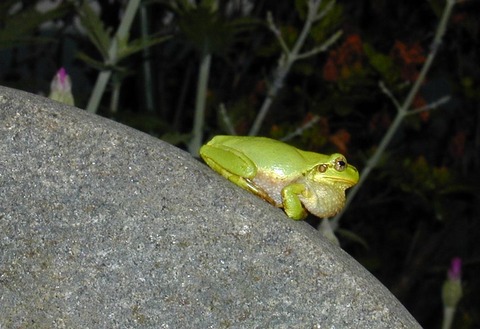
green frog, aogaeru 青蛙 Species Hyla
tree frog, rain frog, amagaeru 雨蛙
summer frog, natsugaeru 夏蛙
river frog, kajika 河鹿, kajikagaeru 河鹿蛙 Polypedates buergeri
river frog song (lit. flute), kajijabue 河鹿笛
..... Kajika is noted for its attractive voice when singing in the river.
. kajika 鰍 (かじか) 杜父魚 bullhead fish, Okoze .
.................................................................................
toad, bullfrog, hikigaeru 蟇蛙 Bufo vulgaris
... also hiki 蟾 or gama 蝦蟇
but
kigo for mid-spring
hiki ana o izu 蟇穴を出づ (ひきあなをいづ)
toad coming out of its hole
..... hiki ana o deru 蟇穴を出る(ひきあなをでる)
..... hiki izu 蟇出づ(ひきいづ)
月の句を吐いてへらさん蟇の腹
tsuki no ku o haite herasan hiki no hara
let me spit out
poems to relieve the belly
of this toad
Buson refers to an old Chinese legend, where a bullfrog lives on the moon. When the frog has eaten too much, its belly begins to swell.
And tonight, Buson has eaten too much while watching the ful moon . . .
. Yosa Buson 与謝蕪村 in Edo .

source : mushroom frog art
The frog (or toad) in the moon
toad as a symbol of yin, and so many Chinese tales refer to the toad whose face is visible at the full moon.
- reference -
:::::::::::::::::::::::::::::::::::::::::::::::::::::::::::::::::::::::::::::::::::::::::::::::::::::
.. .. .. MID-AUTUMN
frogs in autumn, aki no kawazu 秋の蛙 (あきのかわず)
frogs start to hibernate, kawazu ana ni iru 蛙穴に入る(かわずあなにいる)
:::::::::::::::::::::::::::::::::::::::::::::::::::::::::::::::::::::::::::::::::::::::::::::::::::::
.. .. .. Late Winter
Tago frog, tagogaeru たご蛙 (たごがえる)
A variety of red frogs, about 4 cm ling, that live in Honshu and more south. Even in winter it calls for its mate, sounding guuguuguu.
:::::::::::::::::::::::::::::::::::::::::::::::::::::::::::::::::::::::::::::::::::::::::::::::::::::::::::::::
quote
Types of frogs
"So what's the difference between the two words for frog: kaeru and kawazu?" The common answer is that kawazu is the "old word" that got replaced by the "new word" kaeru, but this is a misconception. It's really just another case of semantic overlap combined with poetic versus everyday register.
It's true that there are no kaeru as such in the Manyōshū -- all the frogs that appear as frogs are kawazu (/kahadu/, at the time). But this is not because the word kaeru had yet to be invented.
snip
One reason was that kaeru was a general word, while the original meaning of kawazu seems to have specifically been "kajika frog". The kajika frog is so called because it lives in rivers (ka(wa)) and has a haunting call like a deer (shika), making it ideal for use in poetry. Virtually all of the Manyōshū poems that include a kawazu specifically refer to its call.
Maybe for this reason, kawazu also seems to have been the preferred word in poetry for frogs in general. There is a word for this in Japanese aesthetics: kago (歌語, "poetry word"). Another good example is references to cranes: the word tsuru is plenty old (some say it came over direct from the continent), but most early poems used the word tazu (たづ) instead. That was the kago.
So maybe kawazu originally meant "kajika frog" in particular, but it didn't take long before it just meant "frog [+poetic]" in general. Meanwhile, kaeru was a perfectly healthy synonym meaning "frog [-poetic]".
Eventually, poetry would be modernized in such a way that people felt quite comfortable using the word kaeru, which left kawazu stranded, gradually shifting towards meaning simply "frog [+archaic]". Kaeru, on the other hand, became simply "frog" (unmarked).
Kawazu would probably have been forgotten by all but the specialists by now (much like tazu) if it weren't for one thing: the Dark Side of the Moon of traditional Japanese poetry, that one haikai by Bashō that everyone knows...
source : no-sword.jp/blog
************************************
Worldwide use
Kenya
The bull frog is a rainy season kigo.
It is extraordinarily hard to catch sight of it -- while its voice is an unmistakable sign of the rainy season!
Isabelle Prondzynski
:::::::::::::::::::::::::::::::::::::::::::::::::::::::::::::::::::::::::::::::::::::::::::::::::::::
North America
Spring peeper
kigo for all spring
The Spring Peeper (Pseudacris crucifer, synonym Hyla crucifer) is a small tree frog widespread throughout the eastern USA.
More in the WIKIPEDIA !
new peepers
singing their song of
heart's desire
spring chorus
peepers sing love songs
at sunset
© bob
.................................................................................

source : Native American Design
little frog...
your pad is but a dot
in this old pond
opie, Texas
**********************************
Things found on the way
The famous scroll of the frolicking animals.
Choojuu-giga scrolls (choju giga) 鳥獣戯画
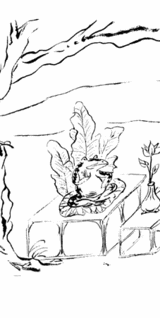
http://www.kokingumi.com/ChojuGiga/66.html
See comment Nr. 2 below.
...........................................

furuike ya Daruma tobikomu mizu no oto
this old pond -
the sound of water
as my Daruma jumps in
© Gabi Greve ..... Look at more !
:::::::::::::::::::::::::::::::::::::::::::::::::::::::::::::::::::::::::::::::::::::::::::::::::::::
"If by sitting in mediation,
one becomes Buddha..."
坐禅して人が仏になるならば

. Sengai Gibon (1751–1837) 仙厓義梵 .
:::::::::::::::::::::::::::::::::::::::::::::::::::::::::::::::::::::::::::::::::::::::::::::::::::::::
Brother Bruno and the frog
When Brother Bruno was at prayer he was disturbed by the croaking of a bull frog. His attempts to disregard the sound were unsuccessful so he shouted,
“Quiet! I’m at my prayers”.
Now Bruno was a saint so he was instantly obeyed. But now another sound intruded – an inner voice – that said, “Maybe God is as pleased with the croaking of that frog as with the chanting of your psalms.
“What can please the ears of God in the croak of a frog?” was Bruno’s rejoinder.
But the voice refused to give up:
“ Why would you think God invented the sound?” Bruno decided to find out. He leaned out of his window and ordered the frog to sing. The croaking filled the air to the ludicrous accompaniment of all the frogs in the vicinity.
As Bruno listened their voices ceased to jar.
If he stopped resisting them, they actually enriched the silence of the night. With that discovery his heart became harmonious with the universe and, for the first time in his life he understood what it means to pray.
Joseph Stoutzenberger - Celebrating Sacraments
source : books.google.co.jp
:::::::::::::::::::::::::::::::::::::::::::::::::::::::::::::::::::::::::::::::::::::::::::::::::::::
akagaeru uri 赤蛙売り selling red frogs
yanagi mushi uri 柳虫売り

source : www.tpa-kitatama.jp/museum
akahikigan 赤蛙丸 "red frog medicine", for children
It helped to quiet down nervous children.

For children, there are also some "mushi" connected with illness like the
san-shi no mushi 三尸の虫 -
kan no mushi 疳の虫 / 癇 insect of nervousness, short-temperedness
nakimushi 泣き虫 insect of crying too much
hara no mushi 腹の虫 insect causing diarrhea
. sanshi no mushi 三尸の虫 The Three Worms .
The red frogs were also eaten in Edo and many parts of the countryside..
. Doing Business in Edo .
*****************************
HAIKU
Furu ike ya kawazu tobikomu mizu no oto
古池や蛙飛び込む水の音
Old pond — frogs jumped in — sound of water
Translated by Lafcadio Hearn
To Japanese of sensitivity, frogs are dear little creatures, and Westerners may at least appreciate this animal’s energy and immediacy. Plop!
30 translations of this famous haiku online are here,
with a Commentary by Robert Aitken
http://www.bopsecrets.org/gateway/passages/basho-frog.htm
Sound of Water
a haiku discussion !!!
xxxxxxxxxxxxxxxxxxxxxxxxxxxxxxxxxxxxxxxxxxxxxxxx
little green frog -
even your voice
the voice of Buddha
Click on the photo to see the whole story
by Gabi Greve
.. .. .. .. .. ..
a frog farting -
this too is the
voice of Buddha
a frog farting -
this too is the
voice of God
More about the Voice of Buddha and Frog
:::::::::::::::::::::::::::::::::::::::::::::::::::::::::::::::::::::::::::::::::::::::::::::::::::::

手をついて歌申あぐる蛙かな
te o tsuite uta mooshiageru kawazu kana
his hands bend down
offering a song -
this frog
or
with a formal bow
he offers a song -
this frog
Yamazaki Sookan 山崎宗鑑 Sokan
(1465 - 1553)
(The Japanese has the kireji KANA at the end of line 3.)
:::::::::::::::::::::::::::::::::::::::::::::::::::::::::::::::::::::::::::::::::::::::::::::::::::::
- - - - - Yosa Buson - and the kawazu, one frog or more frogs . . .
古池の蛙老いゆく落葉かな
furuike no kawazu oiyuku ochiba kana
in the old pond
the frog is getting old
among the falling leaves . . .
The cut marker KANA is at the end of line 3.
春雨や蛙の腹はまだぬれず
harusame ya kawazu no hara wa mada nurezu
spring rain -
the belly of this frog
is not yet wet
朧月 蛙に濁る水やそら
oborozuki kawazu ni nigoru mizu ya sora
misty moon of spring -
water and sky are muddied
by the frogs
泳ぐ時よるべなきさまの蛙かな
oyogu toki yorube naki sama no kawazu kana
when it swims
its has such an unsteady figure
this frog . . .
The cut marker KANA is at the end of line 3.
たたずめば 遠くも聞ゆ蛙かな
tatazumeba tooku mo kikoyu kawazu kana
when I stand still
in the far distance I can hear
the frogs . . .
The cut marker KANA is at the end of line 3.
- - - - - and some personifications
日は日くれよ夜は夜明けよと鳴く蛙
hi wa hi kure yo - yo wa yoake yo to - naku kawazu
during the day "may sunset come"
during the night "may daybreak come"
call the frogs
風なくて雨降れとよぶ蛙かな
kaze nakute ame fure to yobu kawazu kana
"with no wind
let there be some rain !"
call the frogs . . .
During a summer drought, but please no typhoon . . .
The cut marker KANA is at the end of line 3.
. WKD : Yosa Buson 与謝蕪村 in Edo .
:::::::::::::::::::::::::::::::::::::::::::::::::::::::::::::::::::::::::::::::::::::::::::::::::::::
Carpenter frogs
hammering nails out of synch:
"cu-tuck, cu-tuck, cu-tuck..."
Darkened ditch –
the harsh “rraak, rraak, rraak”
of a squirrel tree frog
Pinewood tree frogs
tapping out a telegraph:
"dik-dik-dikadik..."
Zhanna P. Rader
Read more of Zhanna's frog haiku here:
http://groups.yahoo.com/group/happyhaiku/message/1621
xxxxxxxxxxxxxxxxxxxxxxxxxxxxx
frog jumps
reflections
ruined
a tiny frog leaps
out of the moon
creates ripples
Marella Vinodh
xxxxxxxxxxxxxxxxxxxxxxxxxxxx
I remember the very first time that a Japanese friend offered to drive me from the local town to the next one. Sitting in a car offers a great opportunity to say "Stop!" and have a look -- in my case, at a rice field with a young and growing crop. And a green frog on top of one of the blades.
An unforgettable memory.
out of the car --
growing rice field holds a
tiny green frog
Isabelle Prondzynski
xxxxxxxxxxxxxxxxxxxxxxxxxxxxx

marine gallery
army outnumbered
by the navy
M. Shanna Moore, Hawaii
xxxxxxxxxxxxxxxxxxxxxxxxxxxxx
a big splash
and down he went
the prince
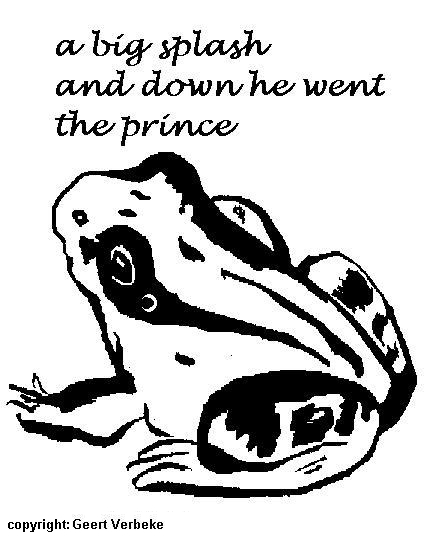
© Geert Verbeke
http://users.skynet.be/geert.verbeke.bowls
:::::::::::::::::::::::::::::::::::::::::::::::::::::::::::::::::::::::::::::::::::::::::::::::::::::
> yasegaeru makeru na Issa koko ni ari
> skinny frog
> don't give up the fight
> Issa is here!
Remarks from Larry Bole : Haiku Information Board
I wonder if thinking of this as a frog "sumo" match, with two frogs facing each other, doesn't give the wrong impression. I think I've seen this activity in some nature film at some time or other, so I have more of an impression of a number of male frogs fighting for position in the process of attempting to mount a female frog.
According to David G. Lanoue, "In his diary, Issa explains, 'I stooped to watch a frog scuffle on the 20th day of Fourth Month.' "
http://www.worldhaikureview.org/3-1/haikuined_dl.shtml
It's a shame that more translators don't include contextual information like this with their translations. I wonder if Issa included anything else in his diary about the writing of this haiku.
Both Makoto Ueda and Haruo Shirane mention the militaristic phrasing found in this haiku.
In his book "Dew on the Grass," Ueda writes:
Issa wrote the frog poem after seeing several frogs fighting for a lone female. The hokku has since become well known for its expression of sympathy toward the weak, but we should also take note of the self-confidence implied in it. Although he himself is a faltering old man,
he is still strong enough to help a frog. "Issa is here," which mimicks the self-announcement of a samurai on the battlefield, adds a touch of humor. [end of comment]
And Haruo Shirane, in his book "Early Modern Japanese Literature: An Anthology 1600-1900," writes:
"Don't give up!" ('makeru na Issa kore ni ari') is a military phrase used by a commander to urge on his troops. [end of comment]
I wonder, when a Japanese person hears this haiku, if they are struck by the military nature of the expression.
Even after over 200 years of relative peace in Japan, a military-style phrase still comes tripping off of Issa's tongue!
I think a spirit of nationalism must have been in the air. Issa certainly felt it when he wrote about geese now being "geese of Japan."
kyoo kara wa Nihon no kari zo raku ni neyo
From today
You're Japan's geese, wild ones,
Rest then in peace!
Issa, trans. Lewis Mackenzie
I wonder even if the "black ships" hadn't appeared when they did, if there still wouldn't have been a "Meiji restoration" at some point, and the renewed militarism which followed.
Larry Bole, February 2008
:::::::::::::::::::::::::::::::::::::::::::::::::::::::::::::::::::::::::::::::::::::::::::::::::::::
Speaking of Frogs
Haibun by Larry Bole, February 2008
Even though it's still winter here in New York City, spring is in the air, or just around the corner, as is said.
So I'm walking down the street in my neighborhood, and suddenly I hear a frog croaking! A frog in this mostly cement-covered neighborhood, with no appreciable body of water nearby except for a few stray puddles left over from last night's sleet shower? A frog in the midst of large apartment buildings crowded up against small, huddled groups of attached houses which have been split up inside into rental apartments, legally or illegally?
Well, some of those attached houses still have pocket-sized gardens out in front which haven't yet been cemented over. So I began my search. The frog croaking seemed to be coming from a small patch of dirt, about five feet by five feet, which was crowded with white plaster rabbits, ducks, and several sets of cherubic children. In the growing season there will barely be room for plants!
Looking and looking I finally spotted it: an accurately painted green ceramic frog sitting on a green ceramic lily pad, afloat on the garden dirt.
A little hole in the frog's open mouth indicated the presence of some sort of electronic soundmaking device hidden inside. Ah, the wonders of modern technology!
spring is in the air!
even the ceramic frog
goes "ribbit! ribbit!"
:::::::::::::::::::::::::::::::::::::::::::::::::::::::::::::::::::::::::::::::::::::::::::::::::::

Haiga by Emile Molhuysen, February 2008
:::::::::::::::::::::::::::::::::::::::::::::::::::::::::::::::::::::::::::::::::::::::::::::::::::
watching the seeds sprout-
guarding a pail of tadpoles
like a mother frog
Lisette Root
Happy Haiku December 2010
:::::::::::::::::::::::::::::::::::::::::::::::::::::::::::::::::::::::::::::::::::::::::::::::::::::
a tiny frog
dancing the jig -
facebook encounters
Look at him here
. Gabi Greve .
July 2012
*****************************
Related words
2008, the Year of the Frog
***** Leap day, leap year 2008
. ANIMALS in all SEASONS - SAIJIKI
The word for frog is pronounced "kaeru."
It is a pun with the word "return home."
Therefore travelers carry a small frog amulet with the intent of returning safely to their family.
. Kaeru omamori カエルお守り 蛙 Frog amulets .
:::::::::::::::::::::::::::::::::::::::::::::::::::::::::::::::::::::::::::::::::::::::::::::::::::::

"Frog Sumo"
Ogata Gekkō (1859-1920)
:::::::::::::::::::::::::::::::::::::::::::::::::::::::::::::::::::::::::::::::::::::::::::::::::::::
[ . BACK to Worldkigo TOP . ]
:::::::::::::::::::::::::::::::::::::::::::::::::::::::::::::::::::::::::::::::::::::::::::::::::::::




 Posts
Posts



43 comments:
kikker in de plomp
hij beweegt in slowmotion
met zijn spiegelbeeld
a frog in the ditch
moving in slowmotion
with his mirror image
Geert Verbeke
Frog and Buddha
There is a famous scroll depicting animals frolicking, mimicking human behaviour. Here the frog comes to mind !!!
Four Choju-giga scrolls
鳥獣戯画
Akiyama Terukazu
The first scroll, consisting of a long sequence of compositions, represents the antics of monkeys, rabbits and frogs parodying human actions--swimming, practising archery, horseback riding and wrestling.
In all these contests it is invariably the underdog who wins. The rabbits, having beaten the monkeys at swimming, are in turn outwrestled by the frogs. Some art historians regard these scenes as social satire alluding to the decline of the aristocracy after the rise of the warrior class.
The end of the first scroll is devoted to a religious ceremony conducted by a monkey dressed as a Buddhist dignitary, solemnly praying before a statue of the Buddha in the guise of a frog seated on a lotus leaf.
This is plainly an ironical "dig" at the clerics of the day. In this first scroll, full of movement and amusing touches, the frolicking animals are vividly rendered with deft and telling strokes of the brush--always in ink.
The same highly skilled technique of ink outline drawing occurs in the second scroll, also of various animals, not humanized now but represented naturalistically: horses, dogs, cocks, etc. Fifteen kinds of real or imaginary animals are treated with naive exactitude and liveliness.
While the scenes of the first scroll are unmistakably satirical, there is nothing of this in the second; these animals have a purely pictorial significance.
Read more about it here
http://kaladarshan.arts.ohio-state.edu/studypages/internal/japan682/Ch5.htm
.. .. ..
There is a slide show about it online
Click on the LEFT arrow, this is in the Japanese order, to proceed.
Choju Giga Slide Show
http://www.kokingumi.com/ChojuGiga/
Here is our FROG in an archery contest
http://www.kokingumi.com/ChojuGiga/17.html
http://www.kokingumi.com/ChojuGiga/18.html
Carrying offerings
http://www.kokingumi.com/ChojuGiga/26.html
Frog and wild boar
http://www.kokingumi.com/ChojuGiga/37.html
Chasing the Monkey
http://www.kokingumi.com/ChojuGiga/43.html
Wrestling with the Rabbit
http://www.kokingumi.com/ChojuGiga/53.html
http://www.kokingumi.com/ChojuGiga/56.html
Finally Frog Buddha and the Monkey
http://www.kokingumi.com/ChojuGiga/66.html
This scroll is one of the fore-runners of Japanese Manga !
Dont miss to look at it.
Gabi Greve
summer rain...
the frog pees
in my hand
Stanford M. Forrester
http://groups.yahoo.com/group/simply_haiku/message/15952
.
Mizu no Oto, sound of water
More Details about the translation of a famous haiku
ROCKET FROG
Rocket frogs, Litoria nasuta in Australia
http://www.faunanet.gov.au/wos/factfile.cfm?Fact_ID=279
Colostethus nubicola
Boquete Rocket Frog
http://www.wildherps.com/species/C.nubicola.html
rocket frog -
another friend
in the old pond
trampling on Asakusa's
little Fuji...
a croaking frog
asakusa no fuji wo fumaete naku kawazu
浅草の不二を踏へてなく蛙
by Issa, 1813
Tr. David Lanoue
...........................
More about Asakusa and the Fuji Worship Groups
get ready to see
my piss waterfall!
croaking frog
shooben no taki wo mishoo zo naku kawazu
.小便の滝を見せうぞ鳴蛙
by Issa, 1812
Tr. David Lanoue
http://cat.xula.edu/issa/
Leap Year of the Frog 2008
leap day -
the haiku frogs jump
to new hights
Gabi
black water--
cricket frogs
sing their swan song
Melcichon
Aklan, Philippines
http://groups.yahoo.com/group/cherrypoetryclub/message/33198
serene and still
the mountain viewing
frog
yuuzen to shite yama o miru kawazu kana
.ゆうぜんとして山を見る蛙哉
by Issa, 1813
This haiku appears in Hachiban nikki, 1813, without prescript, but Issa recopies it six years later in Oraga haru with a prose preface: "In the summer evening, spreading my straw mat, I call 'Lucky! Lucky!' and soon he comes crawling out from his hiding place in the thicket, enjoying the evening cool just like a person."
"Lucky" (Fuku) is a pet name for toads. Shinji Ogawa notes that Issa's first and second lines come from a famous Chinese poem by T'ao Yuan-ming (or T'ao Ch'ien) (365-427). "The two lines depict a very serene and refined tone, and then Issa introduces a frog in the third line. The contrast makes the haiku very humorous."
Tr. David Lanoue
Thomas McAuley and Waka translations
... Moreover, it is said that Emperor Hui of the Jin Dynasty listened to toads at the Garden of Blossoming Trees, and Tachibana no Kiyotomo composed on frogs at Ide. In both Chinese and our own poetry, the places where one listens to frogs are all out among the fields, and in the two previously mentioned Man’yō poems, it is most appropriate to regard them as concerning listening to frogs beneath huts out among the fields in the mountains. ...
http://www.temcauley.staff.shef.ac.uk/waka3097.shtml
This palmetto leaf
whose fingers reach for the sun--
Where did froggy hide?
Daniel Snyder
first frogs -
there is no mud left
in their voices
George Hawkins
a desert road -
teaching my son to drive
we escape a toad
Tomislav
Thanks, Tom, for driving carefully !
蟾親子づれして夕祓
hikigaeru oyako-zure shite yuu- harai
toad parents
bring their children...
evening purification
This haiku refers to a Shinto purification ritual that takes place in Sixth Month in the traditional Japanese calendar. One of the observances is to launch special shrine boats in water; see Kiyose (Tokyo: Kakugawa Shoten, 1984) 162.
Shinji Ogawa adds that the most popular forms of the ritual involve (1) entering a shrine through the chinowa (a large ring made of woven reeds) or (2) going to a river and releasing a paper boat containing a paper doll (katashiro). As the doll drifts away it is thought to take "all unclean things with it."
Tr. and Comment
David Lanoue
summer in the city:
motion-sensor garden frog
croaking and croaking
--Larry Bole
Happy Haiku Forum
Lord Toad
proud to be in charge
of the plum blossoms
蟾どのが何か侍る梅の花
hiki-dono ga nanika hamberu ume no hana
This hokku was written in the 2nd month (March) of 1816, when Issa was living in his hometown. The plum trees are in bloom, and when Issa approaches one tree to view its blossoms he finds an officious toad glaring at him, as if to say "Who are you?"
The puffed up toad seems to think he's in charge of the plum blossoms, as if he were the deputy
of the plum tree god, whom he "serves." The frog has no pecific duty, since he feels he's presiding over the whole tree.
There seems to be an undercurrent of satire in this hokku directed at the samurai class as a whole, especially the pompous daimyo lords and their high-ranking samurai followers.
Chris Drake
Translating Haiku Forum
Matsuo Basho at Obanazawa
這出よかひやが下のひきの声
hai-ide yo kaiya ga shita no hiki no koe
haiide yo kaiya ga shita no hiki no koe
crawl out!
beneath the silkworm shed
the croak of a toad
Tr. Haldane
Kobayashi Issa
朝寒や蟾も眼を皿にして
asa-zamu ya hiki mo manako o sara ni shite
chilly morning --
toad, too, stares
wide-eyed
This autumn hokku was written on the 13th of the intercalary 8th month (October 5) of 1805, when Issa was in a town just east of Edo. In early October it is usually still fairly warm in the daytime in the Edo/Tokyo area, and the hokku is not about the imminent coming of winter. "Chilly morning" refers to one of those days in autumn when the difference between warm day and cool night temperatures has become so great that the early mornings feel cold to people who have just gotten up, even though the temperature isn't that low. The great difference between day and night temperatures also causes a lot of mist, and several of the other hokku in Issa's diary for this day are about mist. The present hokku, too, is visual, and the reader is supposed to imagine what it is that is causing amazement and enlarging the eyes of toads and humans and other creatures.
My guess is that the toad is surprised by the large amount of mist rising up from the pond or lake by which it lives. The temperature is not yet near freezing, and in a couple of hours the sun will have burned off the mist, but the first chilly night and early morning of the autumn and the realization that time is passing are a bit of a shock to humans and apparently to toads, too.
In cities and towns near cities people didn't go into winter confinement. That custom was prevalent in rural areas, especially areas where there was a lot of snow.
Issa and other people living in the greater Edo area didn't ordinarily go into winter confinement, although people living in mountainous areas nearby did.
Chris Drake
Kobayashi Issa
むさい家の夜を見にござれなく蛙
musai ie no yo o mi ni gozare naku kawazu
step right up, see
a filthy human house at night!
croaks the frog
This humorous spring hokku was written on the 27th of the 2nd month (April 4) of 1807, while Issa was staying for five days with some haikai-loving supporters in the town of Tagawa located on the Tone River just northeast of Edo. In contemporary Japan the town is located not far from Narita International Airport.
I take Issa to be writing from the viewpoint of the frogs. The voice quoted in the first two lines of the hokku appears to belong to a full-throated frog who is calling out to other frogs in order to get their attention, much as shouting barkers in the big city of Edo would stand in the street and try to persuade people to enter theaters, events, and shows that displayed all sorts of rare and "freak" people, animals, and objects. Using moderately polite, formal language, the barker frog urges other frogs to stop for a while and enjoy watching a dirty human house and its inhabitants at night in prime time when all the humans are at home and there are more strange, dingy sights to be enjoyed. In Issa's imagination, the frogs are turning the tables on humans, who normally look down on dirty, slimy frogs. Tonight it's the frogs' turn to "observe the natives," to watch and be amazed at the dirty, unnatural way humans live and to feel good about living in frog habitations. No doubt the barker is getting a lot of interested or assenting croaks in reply to his.
For the reading musai ie I follow Maruyama Kazuhiko, ed., Shintei Issa kushuu no. 598.
Chris Drake
.
Kobayashi Issa - Chris Drake
Lord Toad
officially oversees
the plum blossoms
hiki-dono ga nanika hamberu ume no hana
This hokku was written in the 2nd month (March) of 1816, when Issa was living in his hometown. The plum trees are in bloom, and when Issa approaches one tree to view its blossoms he finds an officious toad glaring at him, as if to ask, "Who do you think you are?" The puffed up toad looks as if he thinks he's in charge of the plum blossoms, as if, perhaps, he were the deputy of the plum tree god, whom he "serves" (hamberu). The frog has no specific duty. The verb simply indicates he's serving or waiting on someone more powerful. There seems to be an undercurrent of satire in this hokku directed at the samurai class as a whole, especially at the pompous daimyo domain lords and their high-ranking samurai lordlet followers. For example, in the 2nd month of 1818 Issa satirically evokes the great daimyo lord of Kaga, or Kaga-dono, a lord who serves the shogun by traveling to distant Edo and living near the shogun's castle every other year:
suddenly, in front
of Lord Kaga's procession
a pheasant
kaga-dono no o-saki o tsui to kigisu kana
As Lord Kaga leads a procession of thousands of lesser samurai along the road extending from his domain to Edo, a road that passes through Issa's hometown, a pheasant suddenly begins to walk across the road right in front of the lord. A human might be (and some were) executed on the spot for such a highly disrespectful act, so what will happen to the poor pheasant who knows nothing of class society? Lord Toad in the first hokku above seems to take similar offense at Issa's sudden disrespectful incursion.
In the second line Issa uses hamberu, a variant of haberu, presumably because it sounds more pompous and because without it the second line would have only six syllables. Probably for these reasons, Issa Hokku General Index (444) and Maruyama (Seventh Diary 2.207) read hamberu.
The above is a revised version of my 11/27/2012 post.
Chris Drake
.
Kobayashi Issa
step right up, see
a filthy human house at night!
croaks the frog
musai ie no yo o mi ni gozare naku kawazu
This humorous spring hokku was written on the 27th of the 2nd month (April 4) of 1807. Issa's diary reports that at this time he was staying, for five days, with a haikai-loving supporter, probably the haikai poet and wealthy farmer Iwahashi Ippaku (岩橋一白) in the village of Tagawa (田川) on the northern banks of the Tone River, which ran northeast of Edo and not far north of the area where Narita Airport would later be built. Issa had known Ippaku for a while and often visited his house. Perhaps Issa was joking with Ippaku as they tried to imagine what the frog or frogs were croaking about so loudly near Ippaku's house, and the hokku grew out of their joking. Issa would never call his host's house "filthy" except in fun and ironically, from the frogs' perspective. Then again, Issa could have seen frogs gathering and noisily socializing in front of another house in Tagawa unrelated to Ippaku's house.
The voice quoted in the first two lines of the hokku appears to belong to a full-throated frog (or a group of frogs) who is calling out to other frogs in order to get their attention, much as shouting barkers in the big city of Edo would stand in the street and try to persuade people to enter theaters, performances, and shows that displayed all sorts of rare and "freak" people, animals, and objects. Using the moderately polite, formal language often heard in the streets of Edo's entertainment areas, the barker-like frog urges other frogs to stop for a while and enjoy watching a dirty human house and its inhabitants at night in prime time when most humans are at home and there are countless weird, dingy sights to be enjoyed. In Issa's imagination, the frogs are turning the tables on humans, who normally look down on dirty, slimy frogs. Tonight it's the frogs' turn to "observe the natives," to watch and be amazed at the dirty, unnatural way humans live and to feel good about living in frog dwellings. No doubt the barker is getting a lot of interested or assenting croaks in reply to his.
For the reading musai ie I follow Maruyama Kazuhiko, ed., Shintei Issa haiku-shuu (Revised Collection of Issa Haiku, Tokyo, Iwanami Publs. 1990) no. 598, a hokku very similar to the above hokku.
The above is a revised version of my post on 7/17/2013.
Chris Drake
Nyoirinji 如意輪寺 Nyoirin-Ji Temple
kaerutera, kaerudera かえる寺 "Frog Temple" , "Frogs Temple"
福岡県小郡市横隈1729 Fukuoka prefecture, Ogoori 小郡市 Ogori city, Yokoguma
Check out more than 3000 frog images with wisdom to share !
.
Kondo Shokan 近藤蕉肝
the frogs jumped into the world
世界へ飛んだ蛙
.
Matsumoto
Nawate-dōri (なわて通り) is an old-fashioned shopping street running along the north bank of the river, full of small shops selling antiques, foods, used books, etc. The old movie theater shut its doors after its run of "The Last Samurai", but the posters are still up as well as the nostalgic building itself.
The street's ubiquitous mascot is a frog, originating from frogs in the river as well as a pun on the Japanese word for "return" 'kaeru' (the mountains could be treacherous, frogs were given as a charm so that loved ones would return safely.
.
The main attraction in Matsumoto is obviously the Matsumoto castle, but the city has a lot more to offer to the discerning tourist…
The Nawate Dori (located near the castle’s entrance), with its small restaurants, food shops and antique stores is a great place to spend some time immersed in the local customs. And you will certainly be amazed by the omnipresent frog-themed objects!
You will find here hundreds of frogs, of all sizes, made from all kind of materials, from functional articles to ornaments and lucky charms… The explanation is a wordplay: since the street runs along a small river, there are certainly a lot of frogs here, and in Japanese kaeru means “frog” but also means “return” - so the frogs are good at returning things in your possession - money for example…
Since the whole street is themed with frogs, there are also several frog statues decorating the area and in this photo you can see the most spectacular of them, made from fiberglass by the students of the Tokyo University for Arts. Although it is huge and brightly colored, I almost missed it: I visited Matsumoto in a festival day, so besides the regular shops the street was filled with festival food stalls and the statue was somewhere in the back… It represents two fierce-looking samurai frogs fighting with katana in their hands:
.
Kobayashi Issa
うの花や蛙葬る明り先
u no hana ya kawazu hoomuru akarisaki
deutzia blossoms--
by lantern light
I bury the frog
Or:
"he buries" or "she buries."
Shinji Ogawa helped with this haiku, explaining that akarisaki means simply "the tip of the light." He adds that, since most deutzia blossoms are pure white, the blossoms in the dim light of a lantern make for a "very impressive scene."
.
Tr. David Lanoue
.
frog line-up
Basho takes a peek
at Yahoo
frog kokeshi !!
.
Kobayashi Issa
it lasts all night
even in the well bucket --
croaking frogs
tsurube ni mo hitoyo sugikeri naku kawazu
This hokku is from 10/14 ( Nov. 27) in 1803, when Issa was living in a poor part of Edo and trying unsuccessfully to establish himself as a haikai master. Thus this hokku seems to be a memory of a spring night. In addition to writing, Issa was busy studying ancient Chinese poetry and the Yi Jing, the ancient Chinese Book of Changes divination manual. Prefacing the hokku is the name of the 44th Yi Jing hexagram, often translated into English as "Coming to Meet," although the full title is "Wind Under Heaven, Coming/Happening to Meet." This hexagram consists of a broken (yin) line at the bottom, below five unbroken (yang) lines above, and suggests the appearance of yin within an all-yang situation, as when nights begin to get a little longer after the summer solstice. The power of yin here must be very strong even though it is still small, strong enough to steadily assert itself and grow larger amid a yang environment. The Yi Jing comments that this situation is like a woman who is very powerful and has many lovers -- a woman who (in Confucian terms) is dangerous to marry! The Yi Jing further comments that "meeting" most fundamentally means the meeting of heaven and earth, which allows all things to take on their various visible shapes.
In the hokku the two verbs in the English name of the Yi Jing hexagram, given above the hokku, seem to be reversed. The mating songs of male frogs can be heard here and there and even in the well bucket, which may have some water left in it. Tonight earth and heaven seem to be energetically and loudly mating. A female frog has claimed the well bucket, and there she waited for a meeting. One continually croaking male frog who endured all the travails of becoming the selected one finally entered the bucket, and he continues to sing to his beloved again and again until dawn. As the modern haiku poet Katō Shūson wrote in his book on Issa, "the temporary groom sings his heart out to his one-night bride." Frogs often stay in the mating position for hours at a time or sometimes even for days while the female slowly releases her eggs, and this couple seems to have literally spent the whole night mating. Probably the female chose the male because of his strong voice, and she never tires of hearing it.
Chris Drake
Kobayashi Issa
福蟇も這出給へ蓮の花
fuku-biki mo haiide tamae hasu no hana
even you, lucky toad,
crawl out of there!
lotus blossom
This hokku is from lunar 4/3 or May 20, 1806, when Issa was living in Edo. Since he uses the verb 'crawl,' Issa seems to be standing near a lotus garden, perhaps in a temple or park, and he sees a toad under a low lotus blossom. As in many hokku, Issa uses a warm, lively colloquial expression, so his address to the toad seems friendly.
The prefix fuku- is found attached to the word for toad (hiki) in many rural dialects in Japan. Although it probably originally meant 'puffed up,' a reference to the fact that toads often inflate themselves to look much bigger when they feel they're in danger, the prefix was often written with the character for 'good luck' (also pronounced fuku). Issa uses this character playfully, perhaps suggesting that the toad is lucky to be able to hide under a lotus blossom, but even he can't fool Issa, so he'd better show himself now.
Alternatively, Issa might be bantering with the toad and exclaiming that it's so lucky to be hiding under an incredibly beautiful lotus blossom that hey, it's just not fair - come on out of there!
Chris Drake
.
Legend from Edo
Gama-ike がま池 bullfrog pond
Gama-ike was once part of the estate of Yamazaki Chikara-no-suke, an elite samurai who served the shogun during the Edo Period. Legend tells of a huge bullfrog that lived in the pond and once used its wet, icy breath to stop a fire from razing the neighborhood.
Gama-ike is listed as a cultural treasure of Minato Ward.
.
https://edoflourishing.blogspot.jp/2013/08/edo-nana-fushigi.html
.
Legend from Edo
Tokaiji Nana Fushigi 東海寺七不思議 and 沢庵和尚 Priest Takuan
鳴かぬ蛙 / 鳴かないカエル Frogs that do not croak.
There are many in the large pond, but since one day when they were so lound, priest Takuan shouted at them and scolded them, so they shut up for good.
.
https://edoflourishing.blogspot.jp/2013/08/edo-nana-fushigi.html
.
Legend from Nagano about a toad
Once a Rokubu stayed with a family. They took away all his money and killed him.
They used to money to start a business. But there used to be a lot of toads in their estate. Then an epidemic broke out and the family members died, all of them.
This was the curse of the Rokubu.
https://gokurakuparadies.blogspot.jp/2017/10/rokubu-pilgrims-04-miyazaki.html
.
Legend from Tokyo, 東叡山寛永寺 Ueno Tōeizan Kanei-Ji
gama 蝦蟇 toad,hebi 蛇 serpent
In November 1820 a couple went to 東叡山根岸の弁才天の祠 the Benten shrine in the compound of the Kanei-Ji (Negishi).
That night one of their man-servants had a dream of a toad. The toad said it lived under the kitchen sink and was 癩蝦蟇 Kattai-gama, leprosy toad.
It said the mistress had violated the rules of the shrine visit and next night a serpent would come for revenge. But the Toad would protect them.
Next morning when they looked they found a large dead toad under the sink.
The next night the toad appeared in the dream of the master. It said: "I have died but I left enough children to keep protecting you!"
Then following night the serpent appeared in his dream and said: "From now on, I will also protect your home and family!"
.
https://edoflourishing.blogspot.com/2018/07/negishi-district-taito.html
.
gama 蝦蟇と伝説 Legends about toads
. Gama Sennin 蝦蟇仙人 "Toad Immortal" .
Ri Tekkai 李鐵拐 Li Tie Guai
https://heianperiodjapan.blogspot.com/2018/06/gama-toad-legends.html
.
Legend about kaeru from Nagano
南陽市 Nanyo City
gairaago ガイラーゴ Gairaago
Gairaago looks like a frog, but is very feroucious. When it sees a person, he begins to shout ゲエッ geeee geee and pursues the human, then jumps on it.
Some say it is a toad monster of more than 10 m hight, sometimes coming down from the mountain and crushing the homes of people.
geerago ゲーラゴ a special frog monster
Another monster, like Gairago, living on trees. If a human passed below it, it falls down, clings to the neck and begins to suck blood.
It is about 20 cm long and shouts キーキー gii gii .
It does not have eyes but catches any sound. Its mouth is very large and has fangs.
.
Gairago ガイラゴ
looks like a namekuji ナメクジ slug of about 1 meter long. It crawls around the river pool and when it sees a human it hides in the shade. It does not harm humans, it is very coward.
.
https://edoflourishing.blogspot.com/2019/09/yonezawa-kotaki-kaido-highways.html
.
Hikigaeru legend from Tokyo
.
At a place named 関口 Sekiguchi in Edo there was 水神の社 a Shrine for Suijin the Water Deity. Along the river in front of the Shrine there grew a lot of makomo まこも草 wild rice .
Once 弓職人 a craftsman making bows named Yahei 弥兵衛 passed there when he saw some large shining eyes, about as larte as one seating mat. This was a huge toad.
He was so afraid he run home and stayed in bed for seven days.
.
https://edoflourishing.blogspot.com/2020/05/shokunin-craftsmen-legends.html
.
Legend from 岐阜県 Gifu 大野郡 Ono district 丹生川村 Nyukawa village
.
doosai どうさい / ドウサイ / 蟇 hikigaeru bull frog
Every night there came a beautiful woman to the mountain hut of the forest workers and used itoguruma 糸車 a spinning wheel. They were quite afraid and asked a hunter to shoot her. The next morning there was a doosai hikigaeru frog dead on the ground, with a shot in one eye. It was about 100 cm long.
.
https://edoflourishing.blogspot.com/2020/08/cotton-momen.html
.
Legend from Nagano 諏訪市 Suwa city
.
At 信州諏訪大社 the Great Shrine of Suwa there was a frog venerated at the river 御手洗川 Mitarashigawa, the river where people purify their hands in the water.
Once the Shrine priest cut the ice of the river with an ax and frogs came jumping out. He caught three frogs and used them as an aim for shooting with his arrow.
In the year 1706, on the last day of the year, there was a strong rain and all the ice had melted. So the priest could not get any frogs. But when the first day of the New Year had come, the priest saw three frogs squatting at the stairs to the Shrine. So he could proceede with the rituals.
This is one of the seven wonders of the Great Shrine of Suwa.
.
https://japanshrinestemples.blogspot.com/2020/03/suwa-jinja-legends.html
.
Legends about kajika 河鹿 kajikagaeru, a river frog
.
Toyama, 富山市 Toyama city
Between the eyes of kajika カジカ the local river frogs there is a pattern like fish scales.
In the nearby village of 蜷川村 Hirukawa at 最明寺 the Temple Saimyo-Ji they keep memorials of 北条早雲 Hojo Soun,
who used the fish scale pattern as his family crest.
The memorials were kept at 安養寺 the temple Anyo-Ji before.
.
One more Legend from 岐阜県 Gifu
nagaragawa no kajika 長良川の河鹿 river frog in the river Nagaragawa
This river frog is said to be the spirit of a woman servant of 織田秀信 Oda Hidenobu (1580 - 1605),
who killed herself after he died in 関ケ原 the battle of Sekigahara.
.
https://gokurakuparadies.blogspot.com/2021/10/anyoji-fudo-yoshimi.html
.
Osaka, Shitenno-Ji
In March of 784, the first year of the regency of 桓武天皇 Emperor Kanmu Tenno (735 – 806)
20000 gama 蝦蟇 toads came to the shore at 難波 Nanba and walked to 四天王寺 the Temple Shitenno-Ji.
After showing their respect, the animals scattered.
.
https://gokurakuparadies.blogspot.com/2021/10/shitennoji-temple-legends.html
.
A frog legend from Hiroshima, 三次市 Miyoshi city 吉舎町 Kisa town
.
During the rain season in May, 後鳥羽天皇 the Emperor Gotoba Tenno
(1180 - 1239)
was on his way to 隠岐の島 the Island of Oki for his exile.
The frogs in the wet fields were so loud he could not sleep.
So the Emperor begged the frogs:
"If you are sincere, please stop your noisy croaking."
The noisy frogs soon stopped their croaking.
And now, many hundred years later, the frogs are still not croaking.
.
https://darumapedia-persons.blogspot.com/2022/03/gotoba-tenno-emperor.html
.
Post a Comment